
Focal Points, Sightlines & Axial Design: How to Use Water Features to Guide the Eye
Table of Contents
- Why Water Features Make Strong Focal Points
- Start With the Viewing Point
- How to Use a Fountain at the End of a Garden Axis
- Frame the View
- Create a Vista, Not Just a View
- Reveal or Conceal the Fountain
- Match Fountain Scale to Viewing Distance
- Choose the Fountain for the Visual Role
- Common Focal-Point Mistakes
- A Simple Focal-Point Planning Exercise
- Give the Eye Somewhere to Go
- Frequently Asked Questions About Fountains as Focal Points
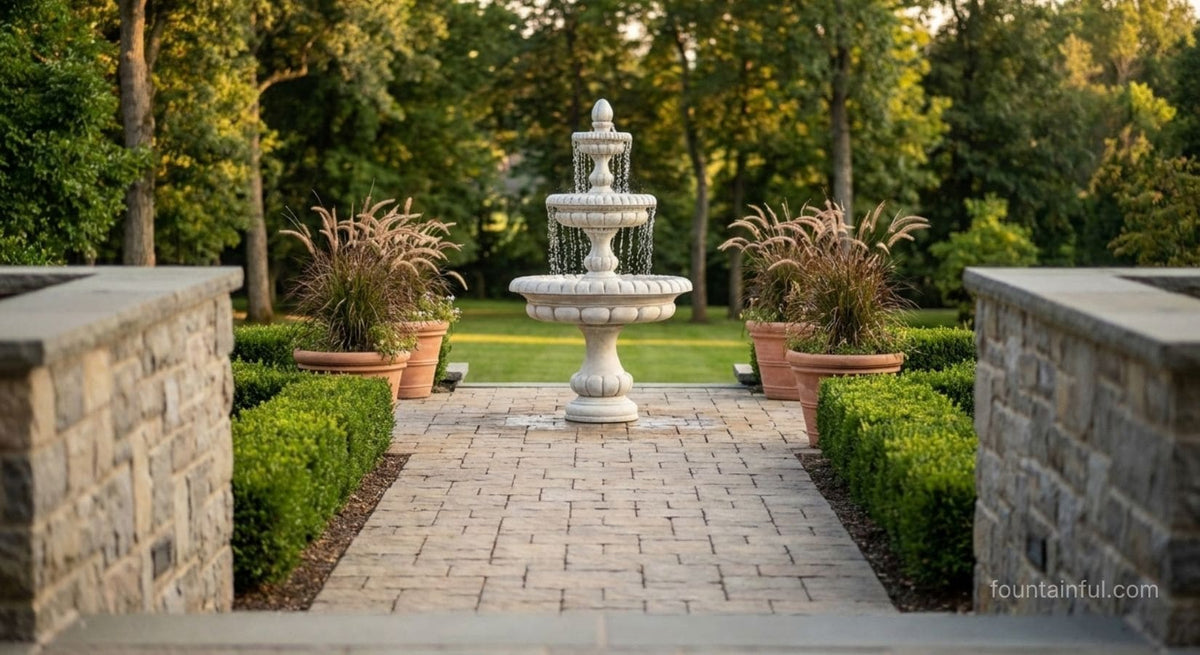
Featured Image: Pioggia 3-Tier Fountain by Fiore Stone
A well-placed water feature does more than fill an attractive spot in the landscape — it tells the eye where to go. Positioned at the end of a path, framed by planting, centered beyond a doorway, or glimpsed across a courtyard, a water feature focal point becomes part of the visual structure of the landscape itself.
For landscape designers, architects, and homeowners, this is where focal points, sightlines, axes, and vistas come into play. The principle is simple:
Decide where people will look from, decide where you want their eye to land, and use the landscape to connect the two.
Water is particularly effective because it combines movement, reflection, sound, and strong form. Used deliberately, it can turn an ordinary view into a composed one.
Why Water Features Make Strong Focal Points
A focal point is the element that naturally attracts attention within a view. That could be a sculpture, specimen tree, architectural feature, or fountain. Water has a particular advantage because it can engage several senses at once. A fountain adds:
- Movement, through falling or flowing water
- Sound, which can draw attention before the feature is visible
- Reflection, through the surface of the basin or pool
- Vertical form, especially with tiered, pedestal, or sculptural fountains
- Contrast, against stone, paving, planting, gravel, or lawn
The fountain does not have to be large or elaborate. A simple feature can become very powerful when the surrounding landscape gives it room to stand out.
Fountainful Tip
The clearer the visual hierarchy around the fountain, the less complicated the fountain itself needs to be.
Start With the Viewing Point
A common mistake is to choose an empty area of the landscape first and then decide what fountain will fit there. A stronger approach is to begin from where the fountain will actually be seen. That might be:
- Through a living-room or kitchen window
- From a patio or terrace
- While approaching the front entrance
- From an outdoor dining area
- At a garden gate
- From a pool deck
- At the start of a pathway
Stand in that location and look outward. Where does the eye naturally travel? Do paving lines, walls, planting, or architecture already point toward something? Is there a strong existing view, or does the eye wander because there is no clear destination?
The relationship can be thought of simply as:
Viewing point → sightline → focal point
For example:
- Patio doors → lawn → tiered fountain
- Garden gate → gravel path → pedestal fountain
- Outdoor dining area → planting → wall fountain
A sightline is simply the visual connection between the viewer and the focal point. If you are still deciding where on the property a fountain should go, start with our guide to water feature placement and landscape design, which covers broader factors such as scale, access, sound, symmetry, and lighting.
For first-time buyers, our guide to choosing your first outdoor fountain also covers practical considerations such as installation, power, maintenance, and fountain weight.
How to Use a Fountain at the End of a Garden Axis
An axis is an imaginary line that organizes landscape elements. In formal gardens, it may be obvious: a straight walkway leading from a doorway to a fountain. In contemporary landscapes, it may be suggested more subtly through paving joints, walls, planting beds, or the home’s geometry. Examples include:
- Front door → walkway → fountain
- Terrace doors → lawn → fountain
- Garden gate → path → fountain
When a fountain sits at the end of that line, it gives the eye somewhere to stop. Without a destination, a long path may feel purely functional. With a fountain at the end, the same path becomes part of a composed view.

At the End of an Axis
This is the most direct approach. A fountain at the far end of a lawn, path, or courtyard can create a strong visual destination, especially when the architecture or hardscape already leads toward it. This works particularly well in:
- Formal gardens
- Courtyards
- Long lawns
- Estate landscapes
- Entry sequences
- Commercial entrances
The longer the viewing distance, the more important the fountain’s overall silhouette becomes. Fine details may disappear from across a large lawn, so height, width, proportion, and visible water movement often matter more than decorative detailing.
At the Center of Intersecting Axes
A fountain can also become the point where several paths or lines meet. This is common in courtyards and formal garden layouts. A freestanding 360-degree fountain works well here because you can view it from multiple directions.

Does the Fountain Need to Be Centered?
No. Perfect alignment creates a strong sense of order, but it doesn’t suit every landscape. In informal or asymmetrical settings, the fountain may sit slightly off-axis while still feeling intentional. The better question is: does the placement make sense from the key viewing points?
Frame the View
A strong focal point becomes even stronger when the surrounding landscape helps frame it. Think of a doorway looking out onto a garden — the doorway defines the edges of the view and makes whatever sits beyond it more noticeable. The same idea works outside.
Use Planting as a Frame
Planting can guide the eye toward a fountain without competing with it. Examples include:
- Clipped hedges
- Matching planters
- Ornamental grasses
- Low shrubs
- Specimen trees
- Low planting around the basin
The aim is not necessarily symmetry. It is to create visual boundaries and enough contrast for the fountain to stand out. Planters are especially useful because they are easier to adjust than permanent planting. See our guide to combining fountains and planters for more ideas.
Also consider mature plant size. A fountain that is beautifully framed in year one can disappear behind overgrown shrubs a few seasons later.
Use Architecture and Hardscape
Architecture can be one of the strongest framing tools. A fountain viewed through a window, doorway, arch, or pergola becomes part of the architectural composition. Hardscape can also direct the eye:
- Long pavers emphasize direction
- Stepping stones suggest movement
- Low walls establish strong visual lines
- Changes in paving can subtly lead toward a destination
Before placing the fountain, look carefully at where those existing lines already lead.
Create a Vista, Not Just a View
A vista is a deliberately composed view with depth. One useful way to think about it is:
Foreground → middle ground → destination
For example:
- Terrace planting → lawn → fountain
- Garden gate → path and planting → fountain
Each layer helps move the eye toward the focal point. Large gardens can create long vistas across lawns or formal axes, while small courtyards can use the same principle over a much shorter distance.
In a compact space, a wall fountain at the far boundary may be enough to create a strong visual destination. The same rules still apply: keep the background clean, avoid visual clutter, and make sure the fountain is large enough to register from the viewing point.
Reveal or Conceal the Fountain
Not every focal point needs to be visible immediately. Sometimes the most interesting landscapes reveal themselves gradually.
Immediate Focal Point
The fountain is visible as soon as someone enters or looks into the space. This works well for:
- Courtyards
- Formal entrances
- Symmetrical gardens
- Commercial arrival areas
- Landscapes with strong architectural geometry
The effect is clear and immediate.
Revealed Focal Point
In a more informal landscape, the fountain may appear gradually. A curved path, planting, or garden wall may conceal part of the feature. The sound of water may become noticeable before the fountain itself is fully visible. This works particularly well in:
- Naturalistic gardens
- Woodland settings
- Informal paths
- Cottage-style gardens
- Larger properties with multiple outdoor rooms
If sound is part of the design goal, our guide to using fountains for noise masking explains how different water patterns influence sound.
Match Fountain Scale to Viewing Distance

Scale isn’t just about whether the fountain physically fits the space. It is also about how the fountain reads from where it will be seen.
Close Viewing
At close range, texture, finish, carving, and water detail matter. This is important for fountains beside patios, benches, courtyards, and outdoor dining areas.
Medium-Distance Viewing
At medium range, overall proportion and silhouette become more important than fine detail.
Long-Distance Viewing
Across a large lawn or long axis, focus on:
- Height
- Mass
- Outline
- Contrast
- Water movement
This is why substantial tiered or sculptural fountains can work well in estate-scale landscapes.
Fountainful Tip
Mark out the proposed dimensions and walk back to the primary viewing point before buying. A fountain that feels large up close can look surprisingly small from 50 or 100 feet away.
Choose the Fountain for the Visual Role
Once the sightline, viewing distance, and focal-point role are clear, fountain selection becomes much easier. Instead of asking only which fountain you like most, ask: what does this location need the fountain to do?
For a Long Axial View
Tiered water fountains work particularly well because their stacked silhouette remains legible from a distance. The Monticello 3-Tier Fountainis a good example of a fountain with enough vertical presence and 360-degree water movement to anchor a larger view.
For a Central Courtyard

Choose a fountain that works from multiple directions. The Large Girona Bowl Fountain offers a low, geometric profile that creates a strong center without needing a traditional vertical fountain.
For a Wall-Terminated View
Outdoor wall fountains are ideal where the sightline ends at a wall or boundary. The Penta Wall Fountain by Giannini uses a broad basin and multiple waterspouts to turn a plain wall into a visual destination.
For a Contemporary Landscape

Look for modern fountains and water features with simple geometry and clean lines that echo the architecture or hardscape. For more inspiration, see our guide to modern water features for contemporary landscapes.
For a Naturalistic Landscape
In a softer or more informal setting, rigid symmetry may feel out of place. A manmade boulder or natural quarried stone fountain can create a focal point while blending more naturally into planting, gravel, or a looser garden composition.
Common Focal-Point Mistakes
Even a beautiful fountain can feel misplaced if you don’t consider the surrounding composition. The most common issues are:
Choosing the Fountain Before the View
Start with the viewing point and visual role first, then select the fountain.
Centering It Automatically
The mathematical center of a yard is not always the visual center. Architecture, pathways, planting, and windows may suggest a better location.
Choosing a Fountain That’s Too Small
A fountain that looks substantial from five feet away may disappear from across a large lawn. Always judge scale from the actual viewing point.
Ignoring the Background
HVAC units, utility boxes, parked cars, busy fencing, or excessive ornamentation can weaken the focal point. A clean backdrop makes the fountain easier to read.
Creating Too Many Focal Points
A fountain, sculpture, decorative bench, planter grouping, and specimen tree can all be attractive individually. Together, they may compete for attention. If the fountain is the primary focal point, let the other elements support it. Apply the same principle when decorating a garden with sculptures.
A Simple Focal-Point Planning Exercise
Before placing a fountain, use this five-step check:
- Stand at the main viewing point. Choose the place where the landscape is experienced most often.
- Notice where the eye naturally travels. Look at pathways, walls, paving, planting, and architecture.
- Decide whether to reinforce or redirect the view. If the current view is strong, build on it. If not, create a better destination.
- Choose the focal point location. Consider the background, distance, and whether the fountain should be fully visible or gradually revealed.
- Strengthen the connection. Use planting, paving, planters, pathways, or architecture to reinforce the sightline.
Then repeat the exercise from one or two secondary viewpoints. A fountain may look perfectly aligned from one doorway but awkward from a nearby patio.
Give the Eye Somewhere to Go
The best fountain placement begins with a view, not an empty patch of ground. By identifying where people will look from, deciding where the eye should travel, and deliberately using sightlines, axes, planting, and scale, a fountain becomes part of the landscape’s structure.
Paths can lead toward it. Planting can frame it. Architecture can align with it. Sound can draw people closer. Before choosing the fountain, stand at the place where you want to enjoy it most and ask: where should the eye land?
Once you know the answer, choosing the right water feature becomes much easier. Explore outdoor water fountains for styles suited to formal axes, courtyards, naturalistic landscapes, and contemporary outdoor spaces.
Frequently Asked Questions About Fountains as Focal Points
What is a focal point in landscape design?
A focal point is the element in a landscape that naturally draws the eye, such as a fountain, sculpture, or specimen tree. A water feature focal point is especially effective because it adds movement, sound, and reflection in addition to form.
How do you use a fountain as a focal point?
Start from the main viewing point — a patio, window, or entry path — and place the fountain where it completes an existing sightline or axis. Scale, framing with planting or architecture, and a clean background all help the fountain read clearly as the destination.
Does a garden fountain need to be centered?
No. Centering works well in formal, symmetrical landscapes, but informal or naturalistic gardens often look more intentional with the fountain placed slightly off-axis. The key question is whether the placement makes sense from the main viewing points, not whether it sits at the mathematical center of the yard.
What is a sightline in landscape design?
A sightline is the visual connection between a viewing point, such as a patio or doorway, and a focal point, such as a fountain. An axis extends this idea into a line connecting several landscape elements, like a front door, a walkway, and a fountain at the far end.
How do you choose the right fountain size for a focal point?
Judge scale from the actual viewing distance rather than the fountain's footprint alone. Fountains viewed up close can rely on texture and detail, while fountains seen across a lawn or long axis need a strong height, mass, and silhouette to register from far away.
Can a small fountain work as a focal point?
Yes. A simple, smaller fountain can be a very effective focal point when the surrounding landscape — planting, paving, or architecture — gives it room to stand out and a clean background to be read against.