
In this article
- Start With the View, Not the Light Fixture
- Highlight Water Movement or Architectural Details?
- Fountain Lighting Techniques at a Glance
- Lighting Ideas for Different Fountain Designs
- Use Light and Shadow to Create Depth
- Make the Fountain Part of the Nighttime Landscape
- Fountain Lighting Safety and Installation Basics
- A Simple Nighttime Fountain Lighting Checklist
- Let Your Fountain Shine Without Overpowering the Garden
- Frequently Asked Questions About Water Feature Lighting
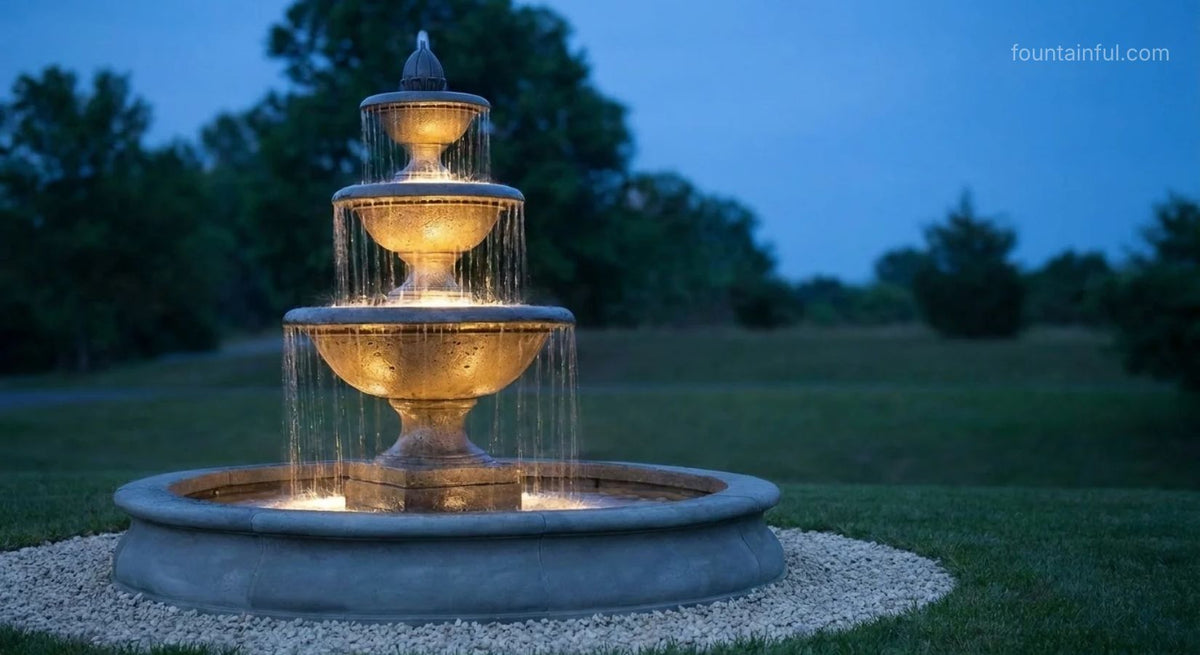
Featured: Monteros 3-Tier Concrete Fountain in Basin by Campania
A well-placed fountain can anchor a garden, draw the eye through a courtyard, or create a quiet focal point beside a patio. During the day, natural light reveals its shape, stone texture, and the movement of water.
After sunset, much of that detail can disappear.
Thoughtful lighting allows a fountain to remain part of the landscape at night. It can highlight cascading water, reveal carved surfaces, and create a welcoming atmosphere around outdoor living spaces.
But effective water feature lighting isn’t simply about making the fountain brighter.
Where the light comes from, what it illuminates, and what remains in shadow all influence the result. A single well-positioned fixture can create a stronger impression than several lights competing for attention.
In this guide, we’ll explore how to use lighting angles, contrast, and viewing positions to make your fountain a natural part of the nighttime landscape.
Start With the View, Not the Light Fixture


Before deciding where to place a light, consider where you’ll be enjoying the fountain after dark.
Will you see it from a patio, an outdoor dining area, or a window overlooking the garden? Perhaps it sits at the end of a walkway, where its shape helps draw the eye through the landscape.
The viewing position should guide the lighting arrangement.
In our guide to water features as focal points through sightlines and axial design, we explain how fountain placement can organize a view and establish visual hierarchy.
Lighting extends those same principles into the evening.
For example, a tiered fountain at the end of a straight garden path may benefit from lighting that reveals its full silhouette. A smaller fountain beside a seating area may look better with softer illumination that emphasizes moving water without overwhelming the surroundings.
Before planning your lighting, ask yourself:
- What should attract attention first? The fountain’s shape, the water’s movement, or a particular decorative detail?
- Where will it be viewed from? A light that works from one direction may create glare from another.
- What surrounds the fountain? Nearby walls, planting, pathways, and existing lights all affect how the fountain appears after dark.
If you’re still planning the layout, our water features in landscape design guide covers how to position fountains within different outdoor spaces.
Fountainful Tip
Stand at your main viewing point after sunset and identify the feature you want people to notice first. Build the lighting arrangement around that detail rather than trying to illuminate everything equally.
Highlight Water Movement or Architectural Details?
Most fountains combine two visual elements: flowing water and structural design. Lighting can emphasize either one, depending on the effect you want to create.
Bringing Moving Water to Life
Water catches and reflects light as it bubbles, splashes, and flows. Illuminating an active area of water can make those movements more visible after dark.
For a cascading fountain, consider highlighting the point where falling water enters the basin. The changing ripples and reflections can create a subtle sense of movement.
For a bubbling fountain, lighting near the water outlet may draw attention to the water as it emerges and travels across the surface.
Submersible LED fixtures can achieve these effects, provided they’re compatible with the fountain and approved for the intended underwater installation. Fixtures made to work in or out of water give you flexibility to aim light at the water or the structure. The IllumiGlow 3-Light LED Kit, for example, includes three warm-white (3,000K) bullet spotlights and a photocell.
The goal is to reveal movement naturally, without making the light source the focal point.
Revealing Shape and Stone Texture
Some fountains are equally impressive for their architectural details. Carefully angled exterior lighting can enhance carved stone, decorative pedestals, tiered bowls, and sculptural surfaces. Instead of positioning a spotlight directly in front of a textured fountain, try directing the light from slightly to one side.
This creates gentle shadows across raised details, making the surface appear more three-dimensional. The difference is especially noticeable on traditional cast-stone fountains, where carved ornamentation contributes much of the design’s character.
For sculptural fountains, angled lighting can help reveal curves and contours while preserving the overall silhouette.
Fountain Lighting Techniques at a Glance

Lighting designers use a handful of techniques to light water features. Most fountains look best with just one or two of them.
| Technique | How it works | Best for |
|---|---|---|
| Uplighting | A fixture at or below the base, aimed upward | Tall or tiered fountains, falling water, and sculptural forms |
| Downlighting | A fixture mounted above, such as in a tree or on a structure, aimed down | Soft, natural-looking light over a basin or nearby seating |
| Side (grazing) light | A fixture close to the surface, angled from one side | Carved stone, reliefs, and textured wall fountains |
| Silhouetting | Light placed on what sits behind the fountain, so its outline stands out | Fountains with a strong profile, viewed from a distance |
| Submersible lighting | Waterproof fixtures placed in the basin or water | Making streams, bubbles, and ripples glow |
Lighting Ideas for Different Fountain Designs
Different fountain styles offer different opportunities for nighttime lighting. The most effective approach responds to the feature’s shape, scale, and water movement.
Tiered Fountains: Emphasize Height and Cascades
Tiered garden fountains naturally create a vertical focal point. Their stacked bowls, central pedestals, and falling streams provide several layers that can be highlighted after dark. When viewed from across a courtyard or lawn, revealing the overall height and outline often matters more than illuminating every carved detail. You might emphasize the upper tiers with a soft exterior light while allowing the falling water to catch illumination below.
For a smaller tiered fountain, a single well-positioned fixture or an existing built-in lighting system may provide enough definition.
The key is to preserve the relationship between the fountain’s structure and the movement of water.
Wall Fountains: Reveal Texture Without Glare
Wall fountains often feature carved reliefs, decorative surfaces, or water flowing down a vertical face. Angled lighting can reveal their texture, but smooth wet surfaces may also produce strong reflections.
If the fountain faces a patio or outdoor dining area, check the effect from those positions. A spotlight that looks attractive when standing beside the fountain could create uncomfortable glare when viewed from a chair.
In compact courtyards, a restrained beam that highlights selected details often creates a more balanced result than illuminating the entire wall.
Bubbling and Sculptural Fountains: Focus on One Detail

Bubbling fountains and abstract water features frequently have one defining element. It might be a central water outlet, a curved stone surface, or an unusual sculptural form. Instead of evenly illuminating the entire feature, focus on the detail that gives it character.
For a bubbling stone column, that may be the point where water emerges. For a sculptural fountain, it may be the outline or surface contours.
Consider viewing distance, too. Fine texture becomes more noticeable up close, while the overall silhouette is more important when the fountain is viewed from farther away.
Use Light and Shadow to Create Depth
One of the most common fountain lighting mistakes is assuming that every surface needs to be bright. In reality, shadow matters as much as light.
A carved fountain illuminated evenly from the front may appear flatter than the same fountain lit from an angle. Gentle changes in brightness help distinguish raised details, recesses, and overlapping forms.
The same principle applies to moving water. A few carefully illuminated streams can create a more natural effect than making the entire basin glow.
Try to establish a visual hierarchy:
- Make the fountain’s most important feature the brightest or most noticeable element.
- Use softer illumination to reveal secondary details.
- Allow less important areas to remain in shadow.
This creates depth without overwhelming the overall design.
Choose a Light Color That Complements the Garden

Color temperature also influences how a fountain appears. Warm-white lighting, typically around 2700K–3000K, often complements traditional stone finishes, warm-toned paving, and natural garden materials.
Neutral or cooler white lighting may suit certain contemporary fountains with cleaner lines and modern finishes. Our guide to modern water features for contemporary landscapes shows the kinds of designs that pair well with it. Look at the surrounding landscape before making a decision.
If the nearby pathways and outdoor seating areas already use warm lighting, a noticeably cooler fountain light may feel disconnected from the rest of the garden.
Color-changing lights can suit parties or seasonal displays, but a single warm or neutral white tone usually looks more natural for everyday use.
A consistent lighting atmosphere usually creates a more cohesive result.
Make the Fountain Part of the Nighttime Landscape

Even when a fountain is the main focal point, it shouldn’t feel isolated from its surroundings. Nearby path lights, wall fixtures, and illuminated planting all influence the nighttime composition.
If those elements are significantly brighter than the fountain, they may compete for attention. If the fountain is dramatically brighter than everything around it, it can appear disconnected from the garden.
Consider how the eye moves through the space.
In a formal landscape, lighting can reinforce a central axis and lead attention toward the fountain. In a naturalistic garden, softer lighting may reveal the water feature among planting and irregular paths.
Plants and decorative containers can also help frame the composition. Our guide to combining fountains, planters, and potted plants explores how different heights, materials, and planting arrangements can complement a water feature. At night, subtle lighting can preserve that relationship without making every element equally prominent.
Try to keep fixtures discreet and avoid directing bright beams toward windows, walkways, or seating areas. The goal is to make the fountain feel like a natural extension of the landscape, rather than a separate illuminated object.
Fountain Lighting Safety and Installation Basics
Water and electricity call for extra care. A few ground rules apply to almost every installation:
- Use fixtures rated for how they’ll be used. Only fixtures labeled for submersion belong underwater. Fixtures rated just for outdoor use should stay above the waterline.
- Choose low-voltage landscape lighting. A listed low-voltage transformer is the common approach for water features, rather than standard household-voltage fixtures near water.
- Protect the circuit. Outdoor circuits that power a fountain, pump, or lights should be GFCI-protected.
- Keep connections dry. Make cable splices and connections outside the water, using connectors or junction boxes rated for outdoor use.
- Automate it. Many kits include a timer or photocell, so the lights come on at dusk without any effort.
- Call a licensed electrician for new wiring. Check local code and permit requirements before you begin.
This is general guidance. Always follow the installation instructions that come with your fixtures, and ask a licensed electrician about anything you’re unsure of.
A Simple Nighttime Fountain Lighting Checklist
Before finalizing the lighting arrangement, work through these five steps:
- Choose the main viewing point. Start at the patio, window, or garden path where you most often see the fountain.
- Identify the focal feature. Decide whether the moving water, architectural structure, or sculptural details should attract attention.
- Plan the lighting angle. Use directional light to reveal texture and movement while avoiding glare.
- Consider the surroundings. Coordinate the fountain lighting with nearby pathways, planting, and architectural features.
- Evaluate the effect after dark. Where practical, test the proposed positions using appropriately rated lighting before committing to the installation.
Small adjustments in angle or intensity can make a noticeable difference.
Let Your Fountain Shine Without Overpowering the Garden
Good water feature lighting doesn’t need to announce itself. It should reveal the qualities that made the fountain worth placing in the landscape: flowing water, natural texture, sculptural form, or its relationship with the surrounding garden.
Just as careful placement and sightline design guide the eye during the day, thoughtful lighting can preserve that sense of composition after sunset.
Start with what you want people to notice. Consider where they’ll be viewing it from. Then choose lighting that supports the fountain’s design rather than competing with it.
Once you’ve planned the effect, explore Fountainful’s fountain lighting collection to find equipment suitable for your water feature and outdoor space.
Frequently Asked Questions About Water Feature Lighting
What is the best way to light an outdoor fountain?
Start by deciding what you want people to notice first and where the fountain will be viewed from. Then use one or two directional fixtures to reveal it: submersible or low-angle lights bring out moving water, while angled exterior lights show stone texture and silhouette. Warm white light (about 2700K–3000K) suits most traditional gardens, and fixtures should stay discreet and out of the main line of sight to avoid glare.
Should fountain lights point upward or downward?
Both approaches can work. Uplighting can emphasize vertical forms and cascading water, while lighting directed from above or the side can reveal stone textures and sculptural details. The best angle depends on the fountain’s design and the main viewing position.
How bright should outdoor fountain lighting be?
Brightness depends on the fountain’s size, viewing distance, and surrounding landscape lighting. A small fountain beside a patio often benefits from softer illumination, while a large feature viewed across a garden may require more light. The goal is to reveal the fountain without overwhelming its surroundings.
Can you illuminate a fountain without lighting the entire garden?
Yes. Carefully positioned, appropriately shielded fixtures can direct light toward the fountain while leaving surrounding areas darker. This helps preserve contrast and keeps the water feature as the main nighttime focal point.
What color light is best for a fountain?
Warm white light, around 2700K–3000K, suits most traditional stone fountains and garden settings. Neutral or cooler white can work well with contemporary designs. Whichever you choose, match the other lighting nearby so the garden feels cohesive.
Are fountain lights safe to use in water?
Yes, when the fixtures are rated for submersion, powered through a listed low-voltage transformer on a GFCI-protected circuit, and installed according to their instructions. Have a licensed electrician handle any new wiring.
Can I use solar lights on a fountain?
Solar accent lights can work for small features in spots with reliable sun, but brightness and run time vary with weather and season. For consistent nighttime lighting, a low-voltage kit with a timer or photocell is generally more dependable.