
In this article
- Start With the Landscape — Not the Fountain
- Decide What Role the Water Feature Should Play
- Match the Scale to the Space
- Formal Symmetry or Naturalistic Placement?
- Use Sightlines to Create a Focal Point
- Consider Sound as Part of the Setting
- Think About the Fountain After Dark
- Bring Water, Stone, and Planting Together
- A Quick Fountain Placement Checklist
- FAQ
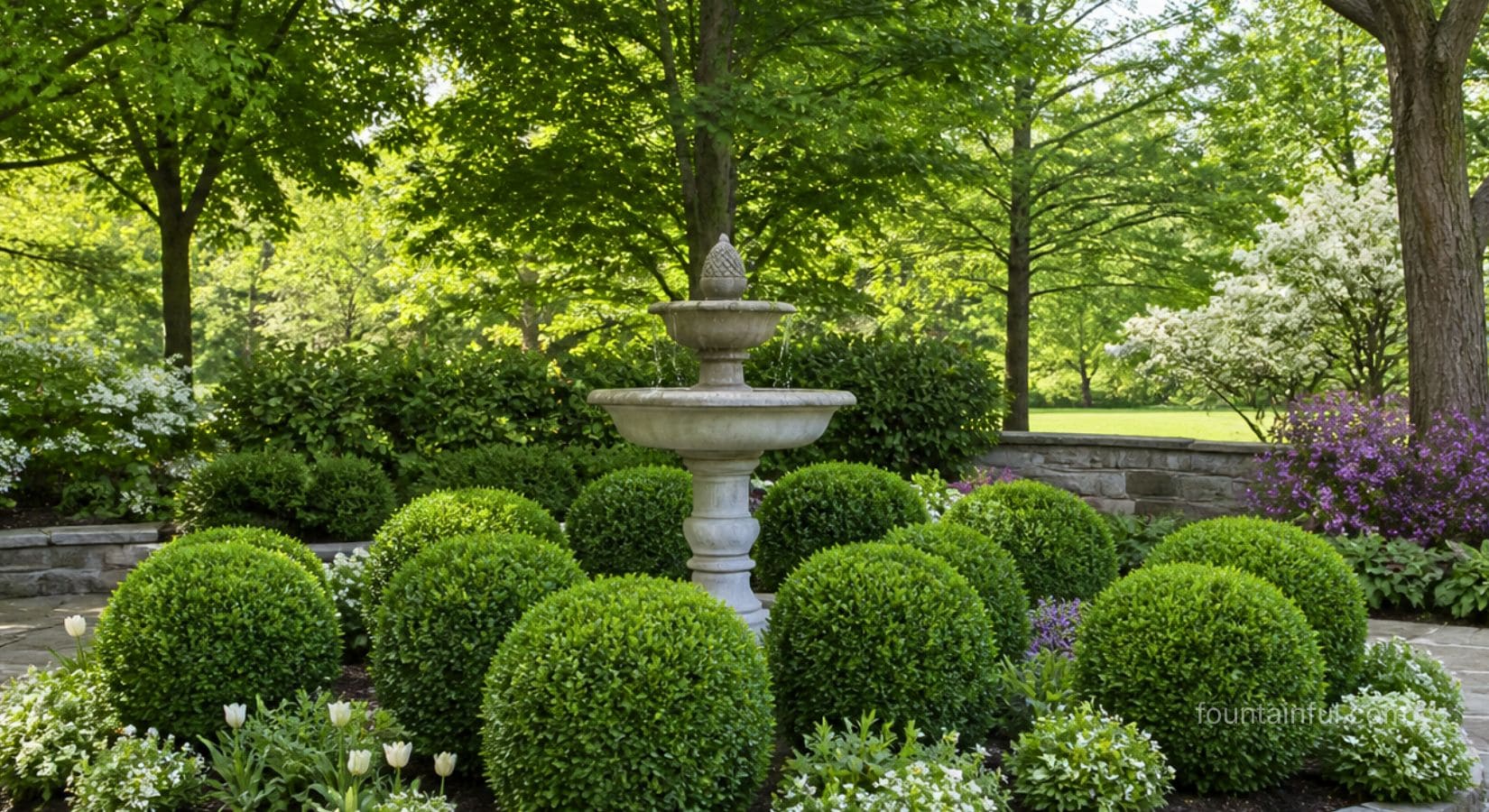
Cover photo generated for illustration; for a similar look, see the Wiltshire 2-Tier Fountain
Water features in landscape design do more than fill an empty part of the garden. Placed well, a fountain can establish a focal point, strengthen a sightline, introduce movement, soften hard landscaping, and change how the entire space is experienced.
The fountain itself is only half of the decision.
A beautiful piece can still feel disconnected if its scale, position, or style works against the surrounding landscape. The strongest installations look as though their location was considered from the beginning. So before choosing a fountain, start with the space.
Where will you see it from? Should it command attention or sit quietly in the background? Does the architecture call for symmetry or a more natural arrangement? How much visual space does the feature need around it?
Answer those questions first, and choosing the right water feature becomes considerably easier.
Start With the Landscape — Not the Fountain

It is easy to find a fountain you love and work backward from there. In practice, placement should guide many of the decisions that follow, including size, style, visual weight, and water movement.
Begin with the places where the fountain will actually be experienced. That might be:
- From a kitchen or living-room window
- From a patio or outdoor dining area
- While approaching the front entrance
- At the end of a garden path
- From a pool deck or seating area
A fountain viewed from across a large lawn has a different job from one positioned beside a patio chair.
Stand at the main viewing point and look toward the proposed location. Notice what sits behind it, how much open space surrounds it, and whether paths, doors, windows, or planting already guide the eye in that direction.
The best location is not necessarily the center of the garden. It is usually the location that works best with the way the space is actually viewed and used. Practical considerations matter too. Access to power, a stable base, falling debris, cleaning access, and seasonal care can all affect whether a location works long-term.
If you are still working through the practical side of choosing your first feature, our first-time fountain buying guide covers placement, power, weight, sound, materials, and winter considerations in more detail.
A strong location should work visually and functionally.
Decide What Role the Water Feature Should Play
Before choosing a fountain style, decide what you want it to accomplish.
Some fountains are intended to become the first thing you notice. A substantial tiered or sculptural fountain positioned in an open lawn, courtyard, or entrance garden can give the surrounding landscape a clear visual anchor.
Others work better as destinations. A fountain placed at the end of a path or long view can draw someone farther into the garden and make separate areas feel connected.
Water can also play a quieter supporting role. Near dining or seating, a smaller feature may be there primarily to introduce movement and gentle background sound rather than dominate the view.
The setting should determine the role.
| Design goal | Typical placement | Fountain character to consider |
|---|---|---|
| Create a focal point | Central position or strong sightline | Strong silhouette, sculptural or tiered form |
| Draw people through the garden | End of a path or vista | Clear shape that reads well from a distance |
| Add background atmosphere | Near seating or dining | Lower profile with restrained water movement |
| Add stronger water sound | Positioned within the main activity area | More pronounced flow or multiple water drops |
A fountain selected to anchor a formal entrance may be completely wrong for a quiet corner beside an outdoor dining table.
Match the Scale to the Space
Dimensions matter, but visual presence matters more. Two fountains with similar footprints can feel completely different once installed. Height, basin width, silhouette, water movement, surrounding planting, and open space all influence how large a fountain feels within the landscape.
Viewing distance changes that relationship.
Fine decorative details become less noticeable across a large lawn, while shape, height, and silhouette become more important. Close to a patio or courtyard, smaller details and surface texture become much easier to appreciate.
Larger features also need room to breathe. A substantial fountain surrounded immediately by dense planting can feel crowded. Giving it some negative space allows the eye to understand its form.
That does not mean a fountain needs to sit alone. Planting can frame a water feature beautifully, but it should support the feature rather than hide it.
For smaller yards, narrow garden beds, patios, and courtyards, our guide to choosing fountains for compact spaces goes deeper into the difference between footprint and visual presence.
Formal Symmetry or Naturalistic Placement?

One of the clearest clues for fountain placement is the architecture already on the property.
Formal landscapes tend to rely on straight lines, repeated shapes, geometric paving, balanced planting, and clear axes. In these spaces, a fountain often feels most convincing when it reinforces that structure.
A front door, central window, walkway, or courtyard can provide a natural line to work from. Positioning the fountain along that line creates order and visually connects it to the home.
Traditional tiered fountains, classical statuary, and geometric forms often work naturally in these arrangements.
Informal landscapes behave differently.
Curved paths, layered planting, irregular groupings, and softer transitions often benefit from less rigid placement. A fountain might sit slightly off-center, emerge from planting, or reveal itself gradually as someone moves through the space.
Architecture can guide the decision without becoming a strict rule.
Georgian and Colonial homes often support stronger symmetry. Mediterranean settings may lend themselves to courtyards and traditional stone forms. Contemporary architecture can work particularly well with clean geometry and sculptural water features, while cottage and woodland gardens generally support softer, more natural arrangements.
For a deeper look at contemporary settings specifically, see our guide to modern water features for contemporary landscapes.
The goal is not to match a fountain to an architectural label.
It is to make the water feature feel as though it belongs to the same visual language as the home and garden around it.
Use Sightlines to Create a Focal Point
A sightline is simply the visual connection between the viewer and an important object.
Stand at a patio door and look across the garden. If your eye naturally lands on one area, that location may already have the makings of a focal point.
An axis takes the idea further. It is an imaginary line connecting important elements within the landscape.
For example:
Front door → garden path → fountain
Placing a fountain at the end of that line gives the view a destination. This can be especially effective in larger gardens, where strong visual connections help organize the landscape.
But not every focal point needs to be centered.
In less formal gardens, an off-axis feature can create a more natural sense of discovery. A fountain that appears gradually along a curved path offers a different experience from one visible immediately from the house.
Statuary can work in much the same way. A figure, urn, or sculptural feature can terminate a view, establish a secondary focal point, or reinforce a fountain's location.
If statuary is playing a major role in the design, our guide to decorating a garden with sculptures covers placement, scale, surrounding planting, and viewing distance in more detail.
For ponds and larger water installations, plumbed-for-water statuary offers another option by combining a sculptural focal point with moving water.
Planting can reinforce the same sightline by framing the destination rather than competing with it. Our guide to combining fountains and planters explores how planters can frame focal points and guide visual flow.
When deciding where a fountain belongs, start with one question:
Where do you want the eye to go?
Consider Sound as Part of the Setting

A fountain is not only something you see.
The movement of water changes how the surrounding garden sounds, so the acoustic character of a fountain should suit the environment in which it is placed.
A quiet courtyard may call for restrained bubbling or a short water drop. In a larger garden or a space affected by road or neighborhood noise, more pronounced water movement may make sense.
Flow rate, drop height, the number of cascades, surrounding hard surfaces, and distance from seating all influence how noticeable the water becomes.
The goal is not simply to choose the loudest fountain available.
It is to make the sound appropriate for the space.
If reducing the perception of traffic or neighborhood noise is one of your main goals, see our dedicated guide to loud water fountains for noise masking. It covers the fountain styles, placement considerations, and water characteristics that produce stronger sound.
That decision is better made deliberately than discovered after installation.
Think About the Fountain After Dark

Lighting determines whether a fountain disappears after sunset or continues to shape the landscape into the evening.
There are two broad approaches.
Submersible lighting emphasizes the water itself. Movement, bubbles, reflections, and falling streams become more visible after dark.
Exterior spotlighting emphasizes the fountain's structure. It can reveal surface texture, sculpture, edges, and shadow.
Larger features can benefit from a combination of both.
The main viewing point matters here too. A light source should reveal the feature without shining directly toward seating areas, windows, or common paths. What looks attractive from beside the fountain may create glare when viewed from the patio.
Plan evening viewing with the same care as daytime placement.
Bring Water, Stone, and Planting Together

A fountain feels most established when it belongs to the composition around it.
A useful way to think about the relationship is:
- Water creates movement.
- Stone provides structure.
- Planting adds softness.
Hard landscaping can help anchor a fountain. Paving, gravel, stone edging, statuary, walls, or planters can create a visual relationship between the feature and the rest of the garden.
Planting then softens those harder elements and helps frame the water. Balance is the goal.
Too much planting can hide the fountain. Too little context can leave it feeling isolated. Use plants to guide the eye, preserve important sightlines, and repeat materials, forms, or tones already present elsewhere in the landscape.
In a sense, composing a garden is a lot like assembling a puzzle: each individual piece — water, stone, a plant, a path — has to be considered in relation to the whole before the picture actually comes together. It's the same patience and eye for how parts interlock that puzzle enthusiasts bring to a table with a Nomad Puzzle, just applied outdoors instead of on a card table.
Apply the same thinking to practical access.
A beautifully planted fountain becomes frustrating if routine cleaning requires cutting through dense shrubs or dismantling surrounding landscaping. Leave enough access to reach the basin, pump, and surrounding surfaces.
Our outdoor fountain maintenance and longevity guide covers the practical requirements worth considering before making a fountain a permanent part of the landscape.
A Quick Fountain Placement Checklist
Before choosing a fountain, ask:
- Where will the fountain be viewed from most often?
- Should it be the primary focal point or a supporting feature?
- Does the home and garden favor formal symmetry or a more organic arrangement?
- Is there an existing path, doorway, window, or sightline worth emphasizing?
- Does the fountain have enough visual space around it?
- What level of water sound suits the setting?
- How will the feature look and function after dark?
- Can the fountain still be reached easily for cleaning and maintenance?
If you can answer those questions before shopping, decisions around style, scale, and placement become considerably easier.
Frequently Asked Questions About Fountain Landscape Design
Where should a fountain be placed in a garden?
Place a fountain where it has a clear relationship with the main viewing area and the role you want it to play. That might be at the end of a path, opposite a patio, within a courtyard, or along an architectural sightline. Also consider power, stable ground, debris, and maintenance access.
Should a garden fountain be centered?
Not always. Centered placement works particularly well in formal landscapes with symmetrical architecture and geometric layouts. Informal or naturalistic gardens often benefit from slightly off-center placement that integrates more naturally with planting and curved pathways.
How large should a fountain be for a yard?
Consider viewing distance and visual presence rather than dimensions alone. Large spaces generally need a stronger silhouette, while courtyards and compact gardens can support more restrained features. Leave enough open space around the fountain for its form to remain clear.
Can a fountain help mask traffic noise?
Moving water can create a stronger acoustic foreground around a patio or seating area. Features with greater flow, taller water drops, or multiple cascades generally produce more noticeable sound. If noise reduction is the main objective, consider fountain type and placement together.