
In this article
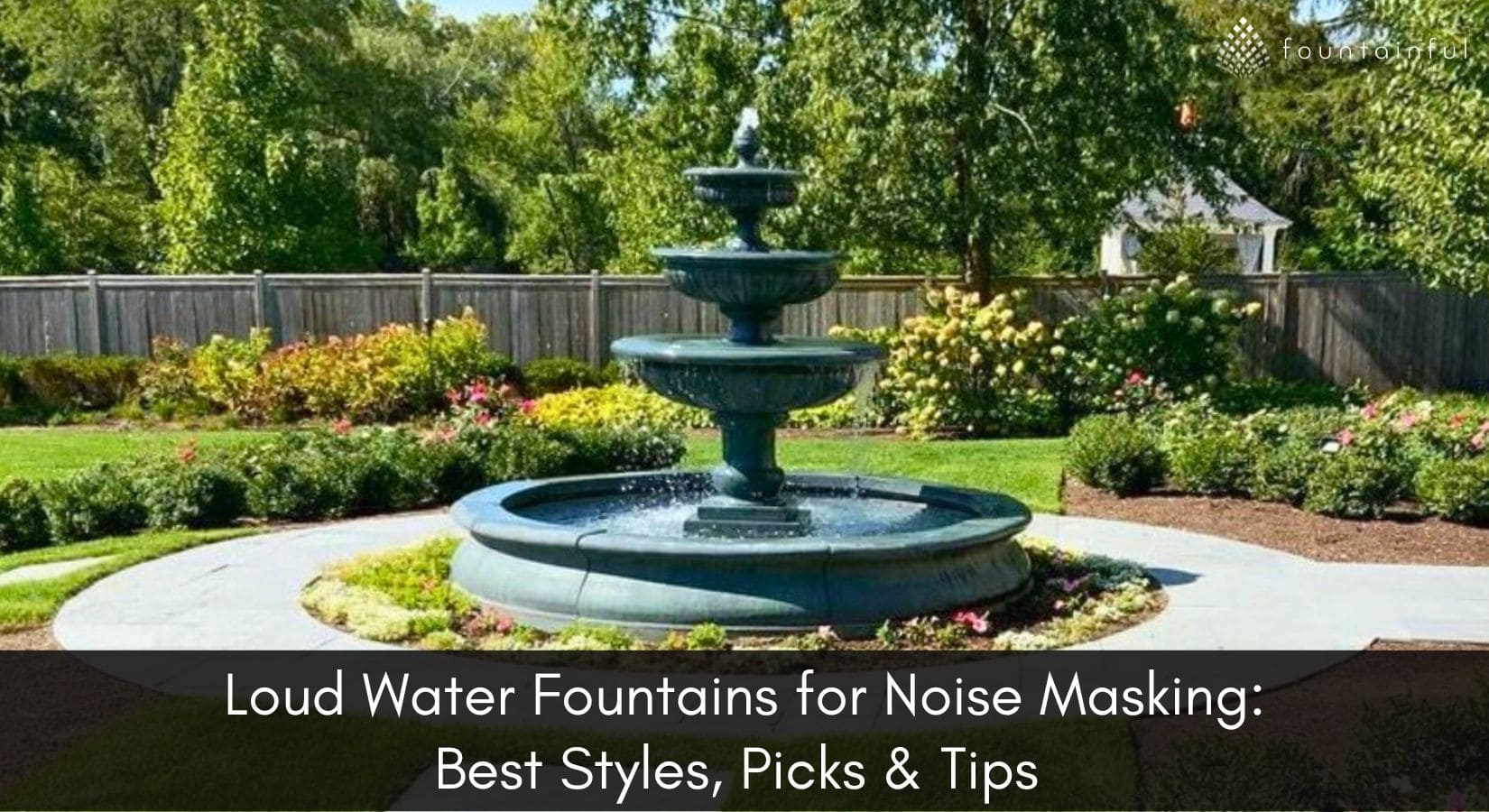
Featured Image: Longvue 3-Tier Estate Fountain by Campania
Photo by: @vanzelstinc
Updated: 07-24-2026
Street noise, traffic, neighbors — unwanted sound is one of the most common complaints among homeowners who love spending time outdoors. And while no fountain is going to turn your urban backyard into a silent retreat, the right water feature can do something remarkably effective: it can mask disruptive noise by replacing it with something far more pleasant to hear.
This technique is called acoustic masking, and it's the same principle behind white noise machines. Rather than blocking sound waves (which requires physical barriers like walls or dense hedging), a fountain floods your outdoor space with the steady, layered sound of moving water — effectively drowning out the irregular, jarring sounds you don't want to hear.
There's real science behind why this works so well. A meta-analysis published in the Proceedings of the National Academy of Sciences found that water sounds produced the largest positive effect on health outcomes of any natural sound studied — outperforming birdsong and other natural audio — and specifically noted water's capacity to mask urban noise while increasing the pleasantness of outdoor spaces.
But not all fountains are created equal when it comes to sound. The style, size, height, and number of water streams all play a major role in how loud a fountain actually is. In this guide, we'll walk you through exactly what to look for — and share our top picks for every outdoor space.

Do Water Fountains Completely Block Noise?
The honest answer is: not exactly — but they can make noise far less intrusive.
Water fountains don't eliminate or absorb sound the way a thick masonry wall does. What they do instead is leverage acoustic masking: the phenomenon where one sound makes another sound harder to perceive. The continuous, broadband sound of flowing and splashing water is particularly effective at this, because it covers a wide range of frequencies — similar to the way white noise machines work indoors.
The result? Traffic, voices, and mechanical hum don't disappear, but they become far less noticeable. Your brain, offered the calming, natural sound of water, naturally shifts its attention away from the intrusive sounds competing with it.
The Science Behind It
Research has consistently shown that exposure to natural water sounds lowers cortisol levels and reduces perceived stress — even when objective noise levels haven't changed. This is why fountains have been used in hospital courtyards, office plazas, and restaurant terraces for decades: not to eliminate noise, but to make the environment feel quieter.
The effectiveness of any given fountain for noise masking comes down to a few key variables:
- Sound output (loudness): A fountain needs to be audible enough to register as a sound "layer" over the background noise. A small tabletop trickle won't compete with rush-hour traffic.
- Sound character: Broadband, complex sounds mask more effectively than simple, tonal ones. Fountains with multiple streams, tiers, or cascading drops produce a richer sound profile that's better at covering a wide range of noise frequencies.
- Proximity: The closer you are to the fountain, the more effective it will be. A fountain 20 feet away is far less effective than one positioned right next to your seating area.

Realistic Expectations
A well-chosen outdoor fountain can meaningfully reduce the perceived intensity of moderate street noise, neighbor conversations, and ambient traffic hum — particularly when you're seated within 10–15 feet of it. For very heavy noise sources (major highways, construction, airports), a fountain alone is unlikely to be sufficient, though it can still be a valuable part of a broader noise-masking strategy alongside fencing, hedging, and landscaping.
What Makes a Fountain Loud? 6 Key Factors
Understanding what drives fountain volume helps you shop with intention rather than guessing. Here are the six factors that most influence how much sound a fountain produces.
1. Drop Height
The greater the vertical distance water travels before hitting a surface, the louder the sound. A fountain where water falls 18 inches produces significantly more noise than one where water flows 4 inches down a gentle slope. When noise masking is your goal, look for fountains with tall tiers or elevated spouts that allow water to drop from height into a lower basin.
2. Number of Water Streams or Tiers

The Tranquility Sphere 3-Tier Fountain by Massarelli features wide scuppers (i.e., slits in the concrete) that channel the water into concentrated streams.
More streams equals more sound — and a richer, more complex sound at that. A four-tier fountain with scuppers on each level is generating sound from eight or more simultaneous streams. A single-spout fountain, by comparison, produces just one. Multiple simultaneous streams also create a more broadband sound that covers more frequencies, making it more effective at acoustic masking.
➤ Pro Tip: “Scupper” is an industry term that simply refers to a “slit” that channels the water into a concentrated stream.
3. Flow Rate and Pump Size
The volume of water moving through the fountain at any given moment directly affects loudness. Higher-flow pumps push more water through spouts and over ledges, creating louder splashing sounds. When browsing fountain specifications, a pump rated for higher GPH (gallons per hour) generally signals a louder, more forceful water flow.
4. Landing Surface and Basin Depth
Where the water lands matters as much as how far it falls. Water landing on a shallow, hard basin produces a sharp, loud splash. Water falling into a deep pool produces a softer, more muffled sound. For maximum noise-masking volume, look for fountains with a relatively hard, shallow landing area — or where water hits another tier of stone or concrete rather than a deep pool.

5. Basin and Body Material
Material affects both resonance and durability. Cast stone and concrete tend to produce a rich, full sound — the material resonates without amplifying harshly. Metal basins can amplify sound (sometimes unpleasantly), while fiberglass tends to dampen it. For most outdoor noise-masking applications, cast stone concrete is the gold standard: loud enough to be effective, natural-sounding in character.
6. Fountain Size and Scale
Simply put, larger fountains move more water and make more noise. If your primary goal is noise masking, resist the temptation to go with a compact fountain to save space. A fountain that is appropriately scaled to your outdoor area — or even slightly larger than you think you need — will perform significantly better as a sound masker.
The 4 Loudest Fountain Styles for Noise Masking
There are dozens of fountain styles on the market, but four stand out as consistently the most effective for generating the kind of loud, rich ambient sound that masks unwanted noise. Here's what makes each one work — and what to look for within each style.
Multi-Tier Fountains

Multi-tier fountains are among the most effective noise-maskers available, and for good reason: each tier acts as an independent sound source. Water cascades from one level to the next, with every descent adding another layer to the overall sound profile. A three-tier fountain essentially gives you three cascades happening simultaneously; a four-tier gives you four.
The key to a loud multi-tier fountain is a combination of drop height between tiers and generous water flow. Tiers that are widely spaced vertically — rather than stacked closely together — allow water to build momentum before landing, producing a satisfying, pronounced cascade at each level.
What to look for: Tiers with generous vertical spacing, wide basins that create audible splashing, and a high-flow pump. The more tiers, the better for sound — though aesthetics and available space should guide your final choice.
Best for: Large garden spaces, central yard focal points, traditional and European-style garden aesthetics.
Scupper-Style Fountains

Scuppers — the narrow, slot-like openings that channel water into a concentrated, forceful stream — are one of the best-kept secrets in noise-masking fountain design. Rather than water gently spilling over a rounded ledge, scuppers concentrate the flow into a tight, high-velocity sheet that produces a sharp, powerful sound on impact.
The sound from scuppers is particularly effective at acoustic masking because it's consistent and forceful — less of a gentle trickle and more of a steady roar. Fountains with multiple scuppers (especially those arranged around all sides of a tier) can generate a wall of sound that competes effectively with significant traffic noise.
What to look for: Fountains with scuppers on multiple tiers or sides, generous water flow to the scuppers, and hard landing surfaces below each scupper opening.
Best for: Contemporary and architectural garden designs, those who want maximum sound from a relatively compact form, spaces where the fountain will be viewed from multiple sides.
Spout Fountains

Spout fountains direct water through distinct nozzle-like outlets, creating streams that arc or jet before landing. The sound profile is different from tiered or scupper fountains — more dynamic and varied, often described as resembling a rushing stream or lively brook. This character makes spout fountains especially pleasant to listen to while still being effective at noise masking.
The key variable with spout fountains is the number of spouts. A fountain with a single spout produces a pleasant sound, but one with five, seven, or nine spouts creates a genuinely rich ambient soundscape — multiple streams landing at slightly different points produce a complex, layered effect that covers more acoustic territory.
Spout fountains also tend to offer significant design versatility, available in everything from sleek, minimalist wall-mounted configurations to ornate freestanding pedestal designs.
What to look for: Multiple spouts (more is better for noise), adequate drop from spout to landing surface, and a pump with sufficient flow to create forceful, audible streams.
Best for: Wall-mounted applications, contemporary spaces, areas where you want design impact alongside sound performance.
Spillway and Wall Fountains

Spillways and wall fountains work differently from tiered or spout fountains — instead of discrete streams, they produce a broad, continuous sheet of water that flows down a flat or gently curved surface into a basin below. Think of the smooth cascade of water over a natural ledge.
The sound character is distinctive: broad, enveloping, and consistent. A wide spillway creates what many describe as a "white noise wall" — an even, omnidirectional ambient sound that's particularly effective at surrounding your space and crowding out external noise.
Water walls, which mount vertically against a fence or exterior wall, are an especially practical choice for smaller urban gardens where floor space is limited. They make excellent use of vertical space and can be positioned directly between a seating area and a noise source for maximum effect.
What to look for: Wide spillway openings (the wider, the more enveloping the sound), significant height above the landing basin, and a high-volume pump that keeps the sheet of water full and consistent.
Best for: Modern and minimalist garden aesthetics, smaller urban spaces, fence-line placement as a noise barrier between street and seating area, commercial and hospitality settings.
Our Top Picks — Best Loud Outdoor Water Fountains
Here are the best sounding water fountains we carry, chosen specifically for their noise-masking performance. These picks span four fountain styles and a range of outdoor spaces — from a patio-friendly tiered basin to an estate-scale statement piece. Each one is selected specifically for its noise-masking credentials, not just aesthetics.
🏆 Best Overall
Geneva 2-Tier Fountain in 46" Basin — Fiore Stone #LG164F46

The Geneva hits the sweet spot that earns it the top pick: classical European design, serious sound performance, and an accessible price relative to the category. Water bubbles from the pinecone finial and cascades down both tiers in concentrated streams before landing in the wide 46-inch basin below — giving you two distinct sound-producing drops plus the broad splash of a large basin landing surface. At 723 pounds of hand-poured cast stone concrete, it has the mass and presence to anchor a patio or garden courtyard while generating the kind of rich, continuous ambient sound that genuinely competes with moderate street noise. Made in the USA by Fiore Stone, a family operation with roots going back to 1949. Pump included.
Dimensions: 67"H | Basin: 46" diameter | Weight: 723 lbs. | Pump: 310 GPH
💪 Best for Heavy Noise / Large Yards
Renault 3-Tier Concrete Fountain with Pool — Massarelli #3665

When the noise problem is serious — a busy road, a highway in earshot, a loud commercial neighbor — you need a fountain that moves serious water. The Renault combines three tiers of cascading concrete with a large pool basin, combinations noted as among the loudest configuration available. Each tier drops water from height before the final cascade thunders into the wide pool below, creating a layered, multi-frequency sound wall that's audible from across a large yard. This is an estate-scale fountain that serves both as a dominant noise-masking tool and a commanding visual centerpiece. Made by Massarelli in New Jersey.
Type: Tiered fountain with pool | Weight: 1,968 lbs. | Style: Classic European
🧱 Best Wall Fountain for Noise
Brentwood Channel Concrete Wall Fountain TALL — Giannini #1826

The Brentwood Channel is purpose-built for sound performance in a wall-hugging form. Its defining feature — the long vertical channels — acts essentially as a continuous wide scupper, producing 11 streams of water that generate a consistent ambient sound rather than a gentle trickle. The tall version maximizes drop height, which as we covered in Section 2 is one of the most reliable drivers of fountain volume. Install it along the fence line closest to your noise source and it becomes a genuine sound barrier between your seating area and the street. A practical, space-efficient pick for urban gardens and narrow courtyards. Made to order by Giannini Garden Ornaments in California.
Dimensions: 5.2 feet tall | Style: Contemporary/Architectural | Placement: Wall, fence, or exterior structure
🎨 Best for Contemporary Spaces
Miramar Concrete Fountain — Giannini #1817

The Miramar is one of the most acoustically efficient fountain designs available — not despite its minimalist look, but because of it. A central sculpted column houses four copper spillways facing each direction, meaning water cascades simultaneously on all four sides into the large square pool below. That 360-degree coverage creates a surrounding sound environment rather than a directional one, making the Miramar particularly effective when placed in the center of a patio or courtyard. The 900 GPH pump pushes enough volume to generate the "strong ambient sound" described on its product page. At 1,200 pounds, it's a serious permanent installation — and visually, it reads equally at home in a modern architectural setting or a transitional garden.
Dimensions: 51" sq. x 37"H | Weight: 1,200 lbs. | Pump: 900 GPH | Water capacity: 80 gallons
👑 Best Statement Piece
Cavalli 2-Tier Concrete Pond Fountain — Fiore Stone #2133

"Cavalli" means horses in Italian, and this fountain earns the name — four masterfully sculpted horses ring the base while horse reliefs continue up through each tier, all crowned by petal-shaped scuppers that channel water into concentrated streams cascading down all sides into the included Fiore Pond below. It's the rare pick that earns Best Statement Piece and Best Noise Masker simultaneously: the scupper-ringed tiers produce exactly the kind of forceful, multi-stream sound profile the acoustic science points to as most effective, while the 86-inch height and nearly 100-inch basin diameter create a fountain that stops visitors in their tracks. At 2,076 pounds with a 1,320 GPH pump, this is a generational garden piece. Handmade in Nevada by Fiore Stone, a family with over 75 years in the craft.
Dimensions: 86"H x 99.5" basin diameter | Weight: 2,076 lbs. | Pump: 1,320 GPH | Design: 17 pieces
⚖️ Best Mid-Size Option
Pioggia 2-Tier Fountain with 55" Basin — Fiore Stone #LG163FB

The Pioggia threads a needle that's hard to find in this category: meaningful noise-masking capability without requiring an estate-sized budget or footprint. The 55-inch basin is the key — it brings pool-fountain splash impact to a two-tier design, meaning water landing in that wide shallow basin generates significantly more ambient sound than a comparable fountain without one. It's a practical choice for a mid-size patio, side yard, or garden courtyard where you want real noise masking performance from a fountain that doesn't overwhelm the space. Made to order in Nevada by Fiore Stone. Pump included.
Dimensions: 5.4 feet tall | Basin: 55" diameter | Style: Classic tiered with pool basin | Made in: USA
How to Maximize Noise Masking from Your Fountain

The Navonna Fountain by Campania features 5 water spouts that flow simultaneously, producing strong ambient sounds in a transitional fountain that fits both modern and traditional décor.
Choosing the right fountain style is only half the equation. Where you place it — and how you configure your outdoor space around it — has an enormous impact on how effective it will be at masking unwanted noise.
Place It Between You and the Noise Source
The most important placement principle: position your fountain between your primary seating area and the noise source. If traffic noise comes from the street to the south, place the fountain on the south side of your patio, not the north. You want to be "behind" the fountain relative to the noise, so the sound of the water is what you're hearing most directly.
Prioritize Proximity Over Size
A moderately-sized fountain placed 8 feet from your seating area will outperform a large fountain placed 30 feet away. The perception of sound drops off quickly with distance — roughly following the inverse square law. If possible, position your fountain within 10–15 feet of where you spend the most time outdoors.
Use Height to Your Advantage
Elevated fountains — or fountains with tall tiers — project sound outward more effectively than low, ground-hugging designs. If you're placing a fountain near a fence line to help mask street noise, consider a taller fountain or a wall-mounted design that brings the sound source closer to ear level.
Consider Multiple Smaller Fountains
For larger outdoor spaces, two or three smaller fountains positioned strategically can outperform a single large fountain in terms of acoustic coverage. Multiple sound sources create a more even distribution of ambient sound throughout the space, rather than one loud point source that fades quickly in all directions.
Combine with Landscaping
Dense plantings — particularly tall ornamental grasses, hedging, and layered shrubs — don't provide significant acoustic blocking on their own, but they work synergistically with a fountain. Plants reduce the visual line to a noise source (which psychologically increases the perceived quietness), create additional white noise in the wind, and help "anchor" the soundscape created by your fountain. Together, a loud fountain and a well-planted garden perimeter can create a genuinely peaceful outdoor room.
Adjust the Pump Flow Rate
Most quality outdoor fountains include pumps with adjustable flow rates. In the evening or early morning when background noise is lower, you can turn the flow down for a gentler sound. During peak traffic hours, turn it up for maximum masking power. This flexibility is worth keeping in mind when evaluating fountain pump specifications.
Not sure which fountain is right for your space? Browse Fountainful's full collections to explore our curated selection of loud, high-performing outdoor fountains — or reach out to our team directly at 214-901-7275 or via our contact page. We're happy to help you find the right fountain for your noise situation, yard size, and aesthetic.
Frequently Asked Questions
How much noise can a water fountain realistically block?
A well-positioned, appropriately sized outdoor fountain can reduce the perceived loudness of moderate street noise by a meaningful margin — often enough to make conversation or quiet reading feel comfortable outdoors. It won't eliminate high-decibel sources like highway traffic or construction equipment, but it can take the edge off significantly and make your outdoor space feel far more serene than it otherwise would.
What fountain style is best for blocking traffic noise?
For heavy traffic noise, scupper-style and multi-tier fountains tend to perform best due to their high sound output and complex, multi-stream sound profiles. Water walls are also excellent, particularly when positioned along the fence line closest to the street.
Does fountain size matter for noise masking?
Yes, significantly. Larger fountains move more water and generate more sound. If noise masking is your primary goal, we generally recommend sizing up — choose a fountain that's slightly larger than you think you need for your space. You can always dial back the pump flow if it feels too loud.
Where should I place my fountain for maximum noise masking?
Position it between your seating area and the primary noise source, within 10–15 feet of where you'll be sitting. Height also matters — elevated designs project sound more broadly than low, ground-level ones.
Can a small or tabletop fountain help with noise?
Small fountains can add pleasant ambient sound to a very intimate seating area, but they're generally not powerful enough to meaningfully mask street traffic or neighbor noise. For true noise masking, a larger floor or wall fountain is recommended.
Is it better to have one large fountain or several smaller ones?
For very large outdoor spaces (especially commercial and public places), two or three smaller fountains distributed around the area often provide better acoustic coverage than a single large fountain. For a smaller patio, courtyard, or the average residential yard, one well-sized fountain positioned strategically is usually sufficient.
Do I need a special pump for maximum noise?
Not necessarily "special," but you do want a pump with a higher GPH (gallons per hour) rating and, ideally, an adjustable flow valve. Many fountains come with pumps included — when evaluating them, check whether the pump is described as high-flow or high-efficiency, and whether the flow rate can be adjusted.