
In this article
- Submersible LED vs. Exterior Fountain Lights: Key Differences
- When to Choose Submersible LED Fountain Lights
- When to Choose Exterior Fountain Spotlights
- Understanding Fountain Lighting Kit Compatibility
- What to Check Before Buying a Fountain Lighting Kit
- Which Lighting Option Should You Choose?
- Find the Right Lighting for Your Fountain
- Frequently Asked Questions About Submersible and Exterior Fountain Lights
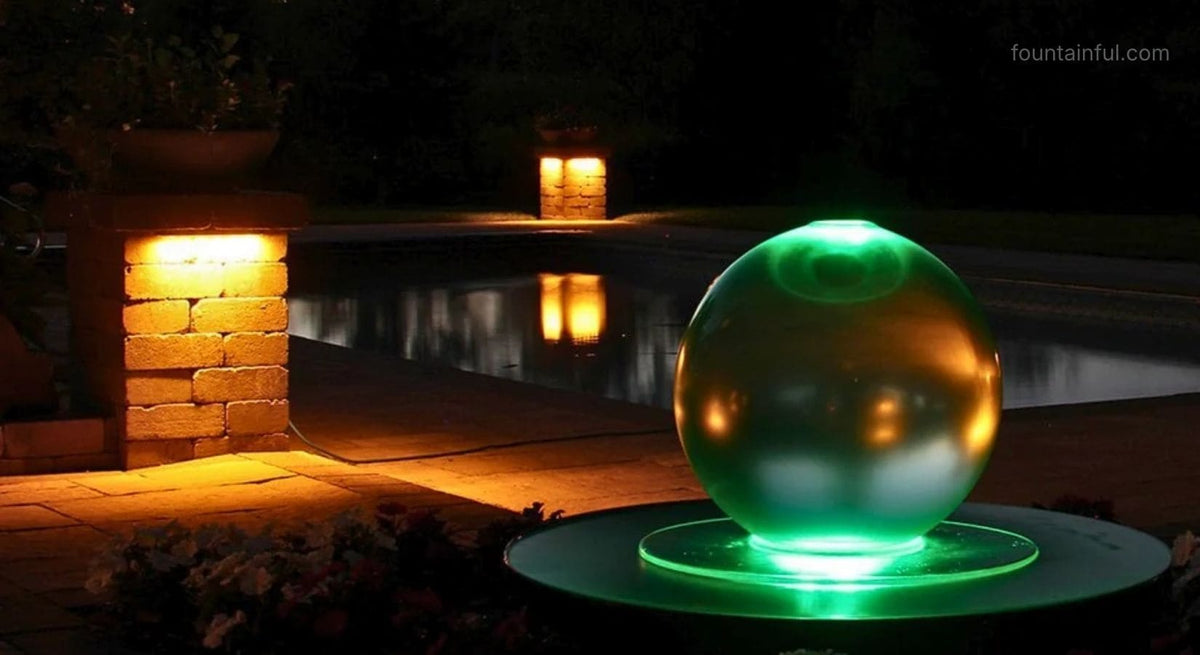
Featured Image: Crystal Sphere (24") Fountain, Blue Thumb
Not all fountain lighting creates the same effect. Some lights illuminate water from within, making bubbles, ripples, and falling streams more noticeable after dark. Others shine onto the fountain from outside, highlighting stone textures, decorative details, and the overall structure.
These two approaches are known as submersible LED lighting and exterior spotlighting.
Both can enhance an outdoor water feature, but choosing the right option depends on more than what looks best.
You also need to consider your fountain’s design, available installation space, electrical requirements, and whether the lighting kit is compatible with your model.
In this guide, we’ll compare submersible and exterior fountain lights, explain when each is suitable, and cover the practical details to check before purchasing.
Looking for design ideas rather than equipment? Start with our guide to water feature lighting ideas, then come back here to choose the right fixtures.

Submersible LED vs. Exterior Fountain Lights: Key Differences
The main difference is where you install the light and what it illuminates.
Submersible LED lights are designed for approved underwater installation. They illuminate moving water, bubbles, and ripples from within or beneath the surface.
Exterior spotlights are positioned outside the fountain and directed toward specific features. They help reveal shape, carved surfaces, and architectural details.
| Feature | Submersible LED Lights | Exterior Spotlights |
|---|---|---|
| Main purpose | Highlighting water movement and ripples | Highlighting fountain shape and texture |
| Placement | Underwater or in approved submerged locations | Outside the fountain |
| Typical applications | Bubbling water, accessible basins, and cascades | Stonework, pedestals, and sculptural details |
| Main installation concern | Waterproofing and internal space | Fixture position and glare |
| Maintenance | Cleaning algae, debris, and mineral deposits | Cleaning lenses and adjusting angles |
| Compatibility | May require fountain-specific mounting or components | Requires suitable outdoor fixtures and placement |
Neither option is inherently better. The right choice depends on what you want to illuminate and what your fountain can accommodate.
When to Choose Submersible LED Fountain Lights
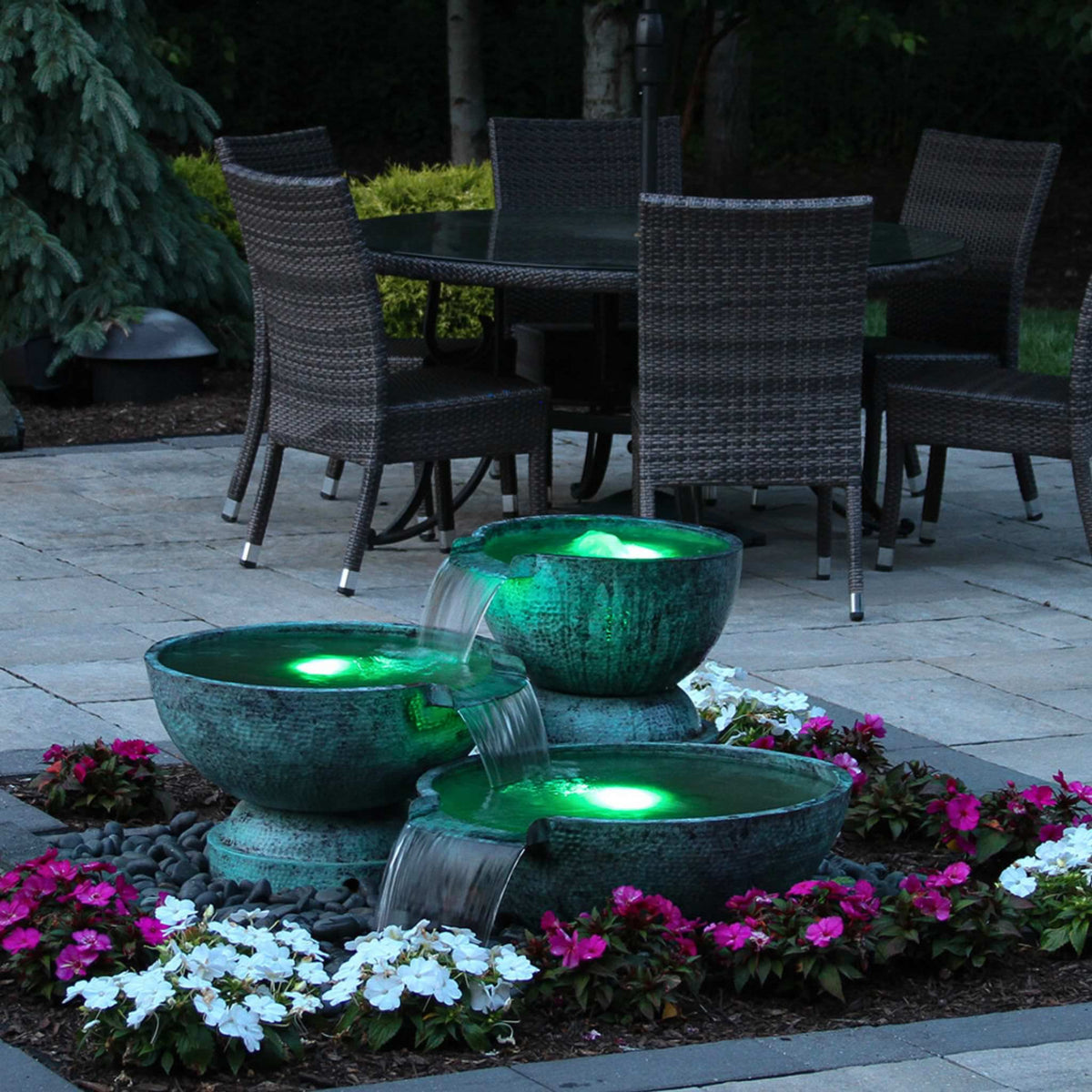
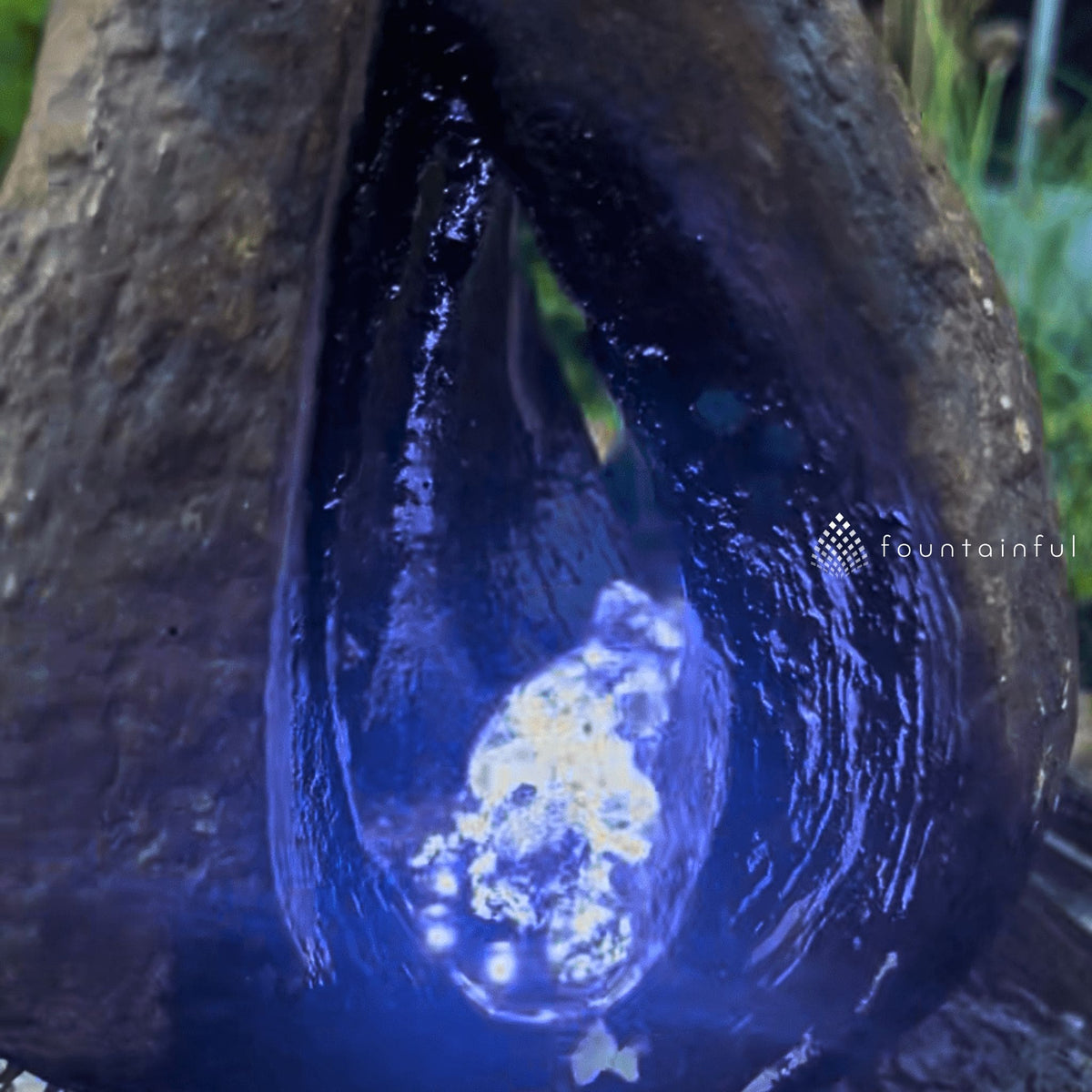
Submersible LEDs are particularly useful when water movement is the fountain’s most appealing feature.
Placed in an appropriate underwater location, they can reveal bubbles, falling streams, and shifting reflections that would otherwise be hard to see after sunset.
For example, lighting near the point where water enters a basin can make the surrounding ripples more visible.
In a bubbling fountain, a suitable light near the outlet may draw attention to the water as it emerges and flows across the surface. However, not every fountain can accommodate an underwater light.
Some basins are too shallow or crowded with pump components. Others have fixed lighting locations or require model-specific fixtures.
Before choosing a submersible kit, check that:
- The fixture is approved for the intended underwater conditions.
- There’s enough room so it doesn’t interfere with the pump or water flow.
- The cable can be routed according to the installation instructions.
- The fixture will be accessible for cleaning.
If your fountain doesn’t have a suitable submerged installation location, exterior lighting may be easier to accommodate.
When to Choose Exterior Fountain Spotlights

Exterior spotlights are a useful option when you want to highlight the fountain’s structure rather than the water itself. They’re particularly effective for revealing carved stone, textured concrete, decorative pedestals, and sculptural surfaces.
Because the fixtures sit outside the water feature, they don’t need to fit inside the basin. However, they still require appropriate outdoor ratings, mounting locations, and electrical connections.
Light direction matters.
A spotlight aimed straight at a patio or window can cause uncomfortable glare. Similarly, a bright beam reflected from a wet surface can distract from the fountain.
Position the fixture so the light falls across the feature you want to emphasize rather than shining toward the viewer. Beam spread matters too: a narrow beam picks out a single detail, such as a finial or carved face, while a wider beam washes light across a larger surface.
If you’re planning the visual effect before selecting equipment, Fountainful’s guide to using water features as focal points through sightlines and axial design explains how viewing positions influence outdoor design. For angles, color temperature, and fixture placement, see our water feature lighting ideas guide.
Can You Combine Both Lighting Methods?
Yes, as long as the fountain can support both installations. A larger fountain with moving water and decorative stonework may benefit from submerged basin lighting and an exterior spotlight directed at the structure. However, a smaller fountain may need only one fixture.
Choose lighting based on the effect you want, not how many lights you can install.
Understanding Fountain Lighting Kit Compatibility
This is one of the most important considerations when purchasing fountain lighting. A kit may look suitable in product photos but still require a specific fountain model, installation method, or power supply.
Fountain lighting products generally fall into a few categories.
Model-Specific Built-In Lighting, Add-On Kits, and Replacement Parts

Some fountains come with lighting built into the design. For example, Fountainful’s Cheshire 2-Tier Concrete Pedestal Fountain by Massarelli already includes LED lighting.
Other fountains let you add lighting when you order. Campania fountains approved for submersible lighting offer a submersible lighting kit as an add-on option right on the fountain’s product page, so the kit you choose is matched to your model. You can also add a Dawn to Dusk Sensor, which turns the lights on automatically at dusk and off at dawn, with no switch or timer to manage. Fiore pond-style fountains also offer a submersible lighting kit as an add-on option. If a model doesn’t list a lighting add-on, don’t assume a universal kit will fit. Confirm compatibility first.
If you own a pre-lit fountain, check the existing lighting system before purchasing additional equipment. Fountainful also offers Massarelli Fountain LED Ring Lighting, an underwater 12-bulb LED light ring available in white or yellow. It’s meant for replacing the lighting in compatible Massarelli models, since a new lighted fountain already includes its ring.
These rings are intended for fountains that specifically list them in their setup instructions. They’re not universal replacement lights for any fountain with a basin.
Always confirm your fountain’s model number and the required lighting components before ordering.
Lighting Kits That Require Special Fountain Preparation
Some systems require the fountain itself to be prepared for the lights. The Blue Thumb IllumiGlow Fountain Plume Lighting 3-Bulb LED Kit is designed for Blue Thumb triple-spouted stone fountains with specially drilled columns. It includes three color-changing RGB LED ring lights, a transformer, and a photocell sensor.
The kit should be selected when ordering the matching fountain so the stone can be drilled when the fountain is made. If purchased separately, you’ll need to arrange for a professional stonecutter to drill the columns. This makes it quite different from a freestanding exterior spotlight that can be positioned beside an existing fountain.
Flexible Lighting Kits
Other systems offer greater placement flexibility.
For example, Fountainful’s Blue Thumb IllumiGlow Fountain Ground Lighting 3-Bulb LED Kit includes three warm-white (3000K) LED lights, each with a 16-foot cord, plus a photocell. It can be used in and out of water, which gives you more options for directing light toward a fountain or selected landscape features. However, flexible installation doesn’t mean universal compatibility.
Check the kit’s mounting instructions, water-depth limitations, and power requirements before deciding where to use the fixtures.
Fountainful Tip
Start with your fountain’s model number and assembly instructions, not the appearance of the lighting kit. Confirm compatibility before purchasing, especially for built-in or specially mounted lighting systems.
What to Check Before Buying a Fountain Lighting Kit

Even after finding a compatible lighting option, a few practical checks can prevent installation problems.
1. Waterproof Ratings
Outdoor and underwater lights are not interchangeable. A fixture suitable for rain exposure is not necessarily designed for continuous immersion.
An IP68 rating indicates protection against continuous immersion under the conditions stated for that product. It doesn’t automatically mean the fixture can operate at any depth or in any fountain.
Check the permitted installation conditions and follow the product’s instructions.
2. Power Supply and Electrical Safety
Confirm whether the lighting kit includes the required transformer, power supply, cables, and connectors.
Check that cable lengths suit the proposed installation and that electrical connections are appropriate for outdoor use.
Install fountain lighting with the electrical protection required for the location, including applicable GFCI (ground-fault circuit interrupter) protection to reduce the risk of electric shock.
Follow the kit’s installation instructions and consult a qualified electrician when electrical work is required or installation details are unclear.
3. Light Color and Controls
Warm-white lighting around 2700K–3000K often complements traditional stone fountains and natural landscaping. Neutral or cooler white lighting may suit certain contemporary designs. Some lighting kits also offer features such as color-changing LEDs or automated operation.
Choose based on how you intend to use the fountain, rather than assuming more lighting features will create a better result.
4. Maintenance Access
Submersible lighting may collect mineral deposits, algae, or debris over time. Exterior fixtures can accumulate dirt or need adjustments as surrounding plants grow.
Before installation, make sure you can reach the fixtures for cleaning and maintenance without dismantling major fountain components.
Which Lighting Option Should You Choose?
Before making your final decision, consider the following:
| Your priority | Consider |
|---|---|
| Highlight ripples, bubbles, or flowing water | Compatible submersible LED lighting |
| Emphasize stone texture or fountain shape | Exterior spotlighting |
| Illuminate both moving water and architectural details | A balanced combination |
| Replace lighting in a pre-lit fountain | Replacement components approved for your model |
| Add lighting when ordering a new fountain | A lighting add-on approved for that model, offered on the product page, with a Dawn to Dusk Sensor available on Campania fountains |
| Add lighting to an existing unlit fountain | A compatible retrofit or exterior system that meets installation requirements |
If you’re still deciding where your fountain will sit within the landscape, our water feature placement and landscape design guide can help you plan the layout before choosing lighting.
Find the Right Lighting for Your Fountain
Good fountain lighting begins with understanding the effect you want to create. Submersible LEDs highlight moving water, while exterior spotlights emphasize shape, stonework, and decorative details.
Both approaches can work beautifully, provided the fixtures suit the fountain and you follow the installation requirements.
Before ordering, check your fountain’s model number, lighting compatibility, power requirements, and access for maintenance. Explore Fountainful’s fountain lighting collection to compare kits and find options that suit your water feature.
Frequently Asked Questions About Submersible and Exterior Fountain Lights
What is the difference between submersible and exterior fountain lights?
Submersible fountain lights are rated for underwater use and illuminate moving water, bubbles, and ripples from within the basin. Exterior fountain lights sit outside the water and are aimed at the fountain to reveal its shape, stone texture, and decorative details. Which one suits you depends on whether the water or the structure is the feature you want to highlight, and on what your fountain can accommodate.
Can I add LED lights to an existing fountain?
Sometimes. It depends on the fountain’s design, available installation space, and the lighting kit’s requirements. Some fixtures can be added to compatible existing fountains, while others need model-specific components or preparation when the fountain is made. If you’re buying a new fountain, check its product page for a lighting add-on approved for that model.
Can exterior fountain spotlights be used underwater?
Only if the fixture is specifically approved for the intended submerged installation. Outdoor weather resistance alone doesn’t make a light suitable for underwater use.
Do submersible fountain lights require maintenance?
Yes. Underwater fixtures can collect algae, debris, and mineral deposits that reduce light output. Follow the kit’s cleaning instructions and safely disconnect power before servicing.
How many lights does a fountain need?
There’s no fixed number. A small fountain may need only one carefully positioned fixture, while a larger feature may benefit from several. The right number depends on the fountain’s design, the desired effect, and compatibility with the installation.
Do fountain lights need a transformer?
Most LED fountain lighting kits run on low voltage, so they typically use a transformer or power supply that is either included in the kit or sold separately. Check what’s in the box before you buy. For example, Fountainful’s IllumiGlow ground lighting kits include the power supply and a photocell sensor. Plug the power supply into a GFCI-protected outdoor outlet, and ask a licensed electrician if new wiring is needed.