
In this article
The pump is the engine of any fountain, and most people only notice it when something goes wrong. Water that barely moves when it should cascade. A spray that pushes clean over the basin edge. A motor that runs loud, hot, and strained when it should barely be noticeable. In most cases, the issue isn't a faulty pump — it's the wrong pump.
Fountain pump sizing feels technical until you understand the few variables that actually matter. After that, it becomes straightforward.
This guide covers what you genuinely need to know to properly size a fountain pump, without turning a decorative water feature into an engineering project.
Good news: you don't have to do any of this math yourself! Every fountain we sell ships with the exact GPH pump recommended by the artisans who built it — sized specifically for that piece's basin, spillway width, and head height. This guide is here so you understand how your fountain works and can make confident decisions if you ever tackle a DIY water feature project down the road, not because you need to size one for your first purchase.
What GPH Means in Fountain Pump Sizing
GPH stands for gallons per hour — the amount of water a pump can move in sixty minutes. A pump rated at 500 GPH can theoretically move 500 gallons of water per hour under ideal conditions. In reality, the actual flow rate changes depending on factors like head height, tubing, nozzle type, and resistance within the system.
More GPH means more movement, stronger flow, and more sound. Less GPH means a softer, quieter effect. Neither is inherently better — the goal is to match the pump's output to the type of fountain you actually want.
Most residential fountain pumps fall somewhere between 100 and 5,000 GPH. The correct range depends on three things:
- The size and design of the fountain
- The visual water effect you want
- How high the pump needs to push the water
How to Calculate GPH for Fountain Pump Sizing
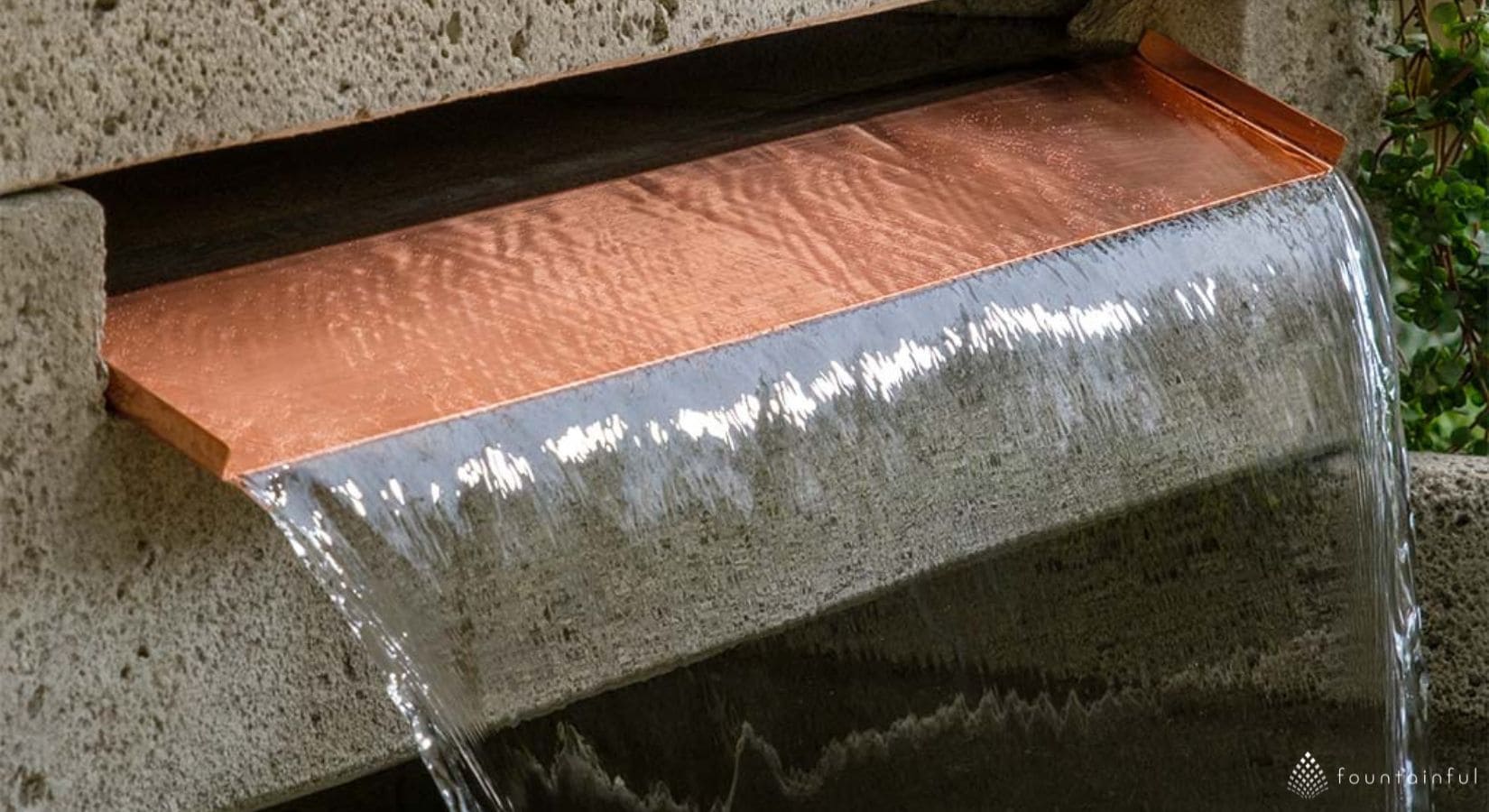
The simplest way to size a fountain pump is to think about the water effect first, then estimate the flow required to create it. Most decorative fountains aren't sized based purely on basin volume — in practice, the width of the water feature and the desired visual effect matter far more.
As a general rule:
- Gentle flow: roughly 50–75 GPH per inch of spillway width
- Moderate flow: around 100 GPH per inch
- Dramatic flow: roughly 150–200+ GPH per inch
For example: a 12-inch spillway with a moderate waterfall effect would typically require around 1,200 GPH. The same spillway with a softer, quieter flow may only need 600 to 900 GPH. This is why two fountains with similar basin sizes can require completely different pumps — the movement of the water matters more than the amount sitting in the basin.

Pump sizing by spillway width: a gentle trickle needs about 50 GPH per inch (600 GPH for a 12" spillway); a standard moderate flow needs about 100 GPH per inch (1,200 GPH for 12"); a dramatic heavy cascade needs 150–200+ GPH per inch (1,800+ GPH for 12")
Calculating Your Fountain's Water Volume
Although visual flow determines most pump sizing decisions, basin volume still matters for circulation and overall system health.
To estimate your fountain's water volume:
Length × Width × Average Depth = Cubic Feet
Cubic Feet × 7.48 = Gallons
For irregular shapes, a rough estimate is usually enough. You're not engineering a dam — you're buying a pump.
As a basic circulation guideline:
- Gentle circulation: roughly half the fountain volume per hour
- Moderate circulation: around the full volume per hour
- Heavy circulation: up to double the volume per hour
These numbers help establish minimum circulation requirements, but they shouldn't override the visual flow requirements of the fountain itself.
Head Height: The Variable Most People Miss
Pump packaging almost always lists GPH at zero head height — meaning the flow rate is measured with little or no vertical lift. The moment the pump has to push water upward, the flow rate drops.
Head height is the vertical distance between the pump and the point where water exits the system, usually the top tier, nozzle, or spillway. A pump rated at 1,200 GPH at zero head height may deliver significantly less once it needs to push water several feet upward.
The practical takeaway is simple: the taller the fountain, the more pump capacity you generally need.
This is why two pumps with the same GPH rating can perform very differently depending on the fountain design. Most manufacturers publish a head height performance chart, worth checking before buying — especially for tiered fountains or waterfalls.
A Simple Fountain Pump Sizing Guide
| Fountain Type | Gentle Flow | Moderate Flow | Dramatic Flow |
|---|---|---|---|
| Small tabletop fountain | 50–80 GPH | 80–150 GPH | 150–250 GPH |
| Small garden fountain | 80–150 GPH | 150–300 GPH | 300–500 GPH |
| Mid-size tiered fountain | 150–300 GPH | 300–600 GPH | 600–1,000 GPH |
| Spillway or waterfall feature | 50–75 GPH/in | ~100 GPH/in | 150–200+ GPH/in |
| Large garden feature | 300–600 GPH | 600–1,200 GPH | 1,200–2,000+ GPH |
These ranges are starting points, not exact formulas. Head height, nozzle type, tubing diameter, and fountain shape all influence final performance.
When in doubt, it's usually safer to size slightly higher and reduce flow with a valve or flow controller if necessary. Most quality pumps include some form of flow adjustment.
Final Thoughts on Fountain Pump Sizing
Choosing the right pump is less about finding the biggest GPH rating and more about matching the pump to your fountain's design. By understanding flow rate, head height, and circulation requirements, you can make more informed decisions and get the water effect you want without wasting energy or money on an oversized pump.
And if you're shopping with us, remember: this decision is already made for you. Every Fountainful fountain arrives with the pump size the artisan spec'd for that exact piece.
FAQs
Do I need to size a pump myself when I buy from Fountainful?
No. Every fountain we sell ships with the exact GPH pump the artisan recommends for that specific piece — sized correctly for its basin, spillway, and head height right out of the box. This guide is for understanding how your fountain works, or for if you ever need to replace a pump down the road.
Can I use a pump with a higher GPH than recommended?
Yes, within reason. Many pumps include adjustable flow controls that allow you to reduce output. A modest increase above the recommended range is usually fine, particularly when accounting for head height. Problems typically arise when the pump is dramatically oversized.
What is the most important factor in fountain pump sizing?
The desired water effect, spillway width, and head height. Basin volume matters for circulation, but flow requirements usually determine the final pump size.
Does higher GPH mean better filtration?
Not necessarily. Higher flow improves circulation, but filtration quality depends on the overall system design, not just pump size. Too much flow can sometimes reduce filtration efficiency by moving water through the system too quickly.
How do I know if head height is affecting my fountain?
Weak upper-tier flow, uneven waterfalls, or poor spray performance are common indicators. If the pump performs well in shallow tests but struggles once installed, the problem is usually head height.
What happens if a fountain pump runs dry?
Running dry is one of the fastest ways to destroy a pump. Without water to cool and lubricate the internal components, the motor overheats rapidly. Even short dry-run periods can significantly shorten pump lifespan. Low-water shutoff systems are worth considering for fountains prone to evaporation or leaks.