
In this article
- Hard Water and What It Leaves Behind
- Soft Water: Cleaner, but Not Without Risk
- What Hard Water Does to Outdoor Fountain Finishes
- Which Material Holds Up Best to Hard Water?
- The Problem With Soft Water
- Testing Hard Water and Soft Water in Outdoor Fountains
- How to Prevent Hard Water or Soft Water Damage on Outdoor Fountains
- FAQs
Hard Water vs. Soft Water for Outdoor Fountains: How Water Chemistry Affects Fountain Finishes
Most outdoor fountain owners focus on the visible signs of wear: algae, discoloration, mineral stains, or a pump that suddenly sounds louder than it should. What many overlook is the water itself — specifically the difference between hard water vs. soft water, and how that chemistry quietly affects fountain finishes over time.
Hard water contains high levels of dissolved minerals, such as calcium and magnesium, while soft water contains far fewer due to natural conditions or water treatment systems. Both can create problems for outdoor fountains, just in very different ways.
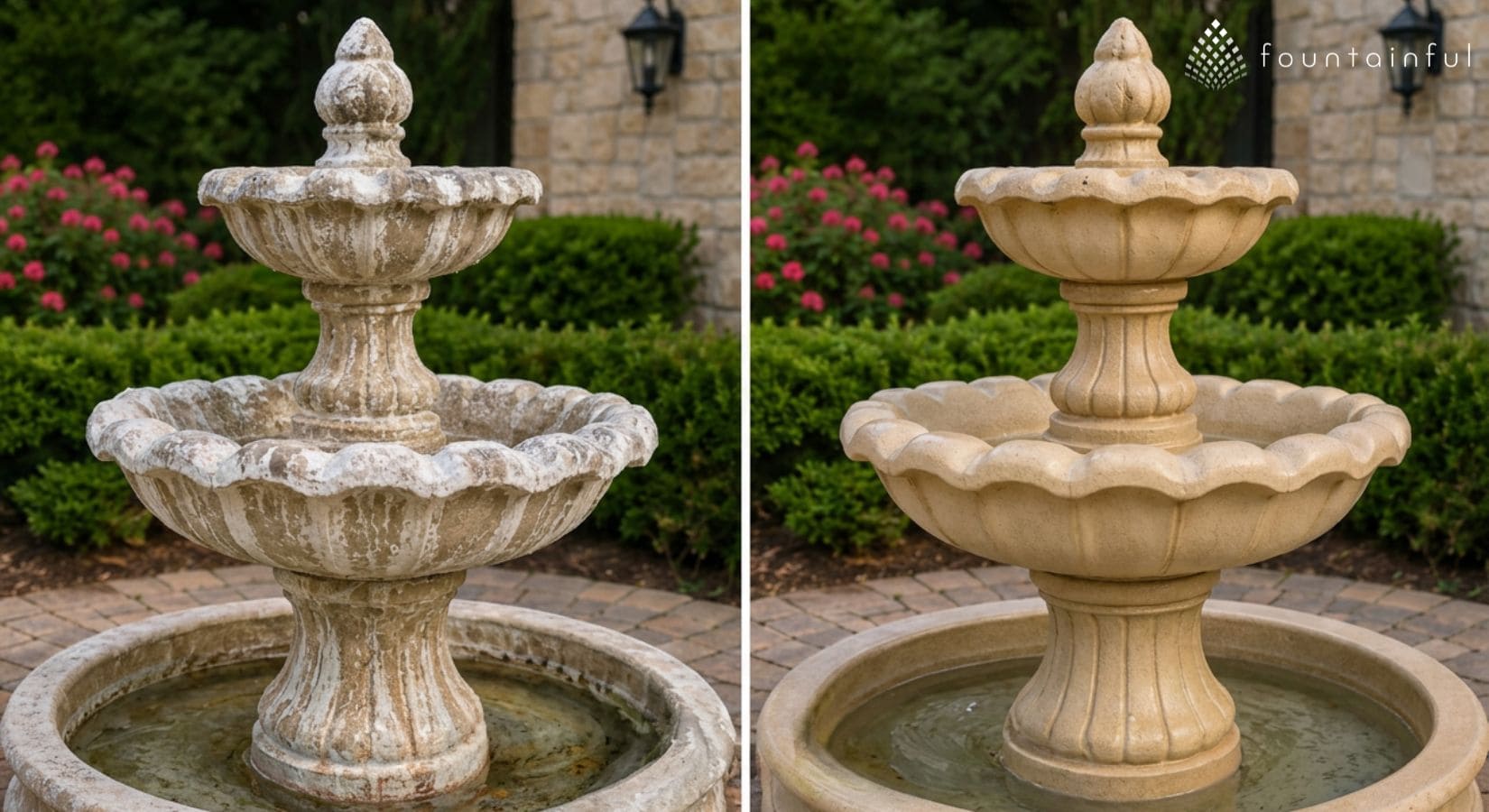
Water hardness is one of the most overlooked factors in outdoor fountain maintenance. It rarely announces itself immediately. A chalky white film gets mistaken for dirt. Water flow weakens slightly as mineral buildup forms inside nozzles and pump components. By the time the damage becomes obvious, the underlying chemistry has often been affecting the fountain for months or even years.
Whether you own a traditional cast stone concrete fountain, a natural rock fountain, copper water feature, tile basin, or stainless steel design, understanding hard water vs. soft water is essential for protecting the finish, preventing long-term damage, and extending the lifespan of your outdoor fountain.
Hard Water and What It Leaves Behind
Water hardness is the concentration of dissolved minerals in your supply — primarily calcium and magnesium, picked up naturally as water moves through rock and soil. The measurement you'll see most often is grains per gallon (GPG): under 1 GPG is soft, above 7 GPG is hard.
In a fountain that re-circulates constantly, those minerals deposit a little more with every evaporation cycle, building up in layers that become increasingly difficult to remove and increasingly damaging over time.
Soft Water: Cleaner, but Not Without Risk
Soft water has had most of its dissolved minerals removed, either naturally or through a treatment system. For scale prevention, that's a real advantage. But most homeowners don't know which type they're working with, and that gap between not knowing and not checking is usually where outdoor fountain damage begins.

What Hard Water Does to Outdoor Fountain Finishes
Mineral-rich water works slowly. The damage depends heavily on the material.
Cast stone and GFRC are porous, so minerals don't just accumulate on the surface — they absorb into it. As minerals crystallize within the pores during evaporation, they expand, creating internal pressure that eventually leads to spalling, flaking, and fractures. By the time visible crusting appears, the process has usually been underway for some time.
Copper and bronze develop patina naturally, and that gradual, even aging is part of the appeal. Hard water disrupts it. Mineral deposits interfere with oxidation, creating blotchy, uneven patches that look like staining rather than character. In areas of heavy buildup, trapped moisture can also accelerate localized corrosion.
Tile and mosaic suffer most in the grout lines, which are porous and absorb minerals before any surface residue becomes visible. Once the buildup causes grout to crack, water intrudes behind the tiles — and what started as a chemistry problem becomes a structural one.
Stainless steel is the most resistant, but not immune. Repeated evaporation cycles leave water spots and mineral staining that becomes progressively harder to remove, particularly around nozzles and high-flow areas.
Which Material Holds Up Best to Hard Water?
Ranked from most to least resistant to hard water damage:
- Stainless steel — the clear winner for hard water conditions. It's non-porous, so minerals can't absorb into the surface the way they do with stone. Expect water spots and mineral staining in high-flow areas over time, but no structural damage.
- Copper and bronze — hold up structurally well, but hard water disrupts the even, natural patina that's part of their appeal, leaving blotchy or uneven staining instead.
- Tile and mosaic — durable on the surface, but vulnerable at the grout lines, which absorb minerals long before any staining is visible and can eventually crack under the buildup.
- Cast stone and GFRC — the most vulnerable to hard water. Their porous surface absorbs minerals directly, and mineral crystallization inside the pores can eventually cause spalling and fracturing.
If you're specifically shopping for a fountain in a known hard-water area, this is worth factoring in alongside style and budget — though regular testing and descaling (covered below) can keep any of these materials in good shape regardless of your water chemistry.
The Problem With Soft Water
Soft water prevents scale, but it introduces a different risk. Water with minerals removed tends to be slightly acidic, and acidic water is corrosive. In a continuously recirculating fountain, this wears on seals, metal fittings, and internal pump components over time. Softened water treated with sodium chloride can also accumulate sodium in a recirculating system, creating its own chemical imbalances.
The takeaway isn't that soft water is bad. It's that water chemistry is never just one variable. pH matters as much as hardness, and both need to be managed together.
Testing Hard Water and Soft Water in Outdoor Fountains
Basic test strips give you a hardness reading and pH level in seconds. For ongoing diagnosis, digital meters are more consistent and worth the investment.
What to look for:
- Hardness above 7 GPG (120 PPM): meaningful scale risk begins here
- pH below 7: acidic water that corrodes metal and etches stone
- pH above 8: accelerates scale formation and reduces water clarity
Test at the start of the season, after any significant refill, and again mid-season.
How to Prevent Hard Water or Soft Water Damage on Outdoor Fountains
Hard water calls for regular descaling with a solution matched to your material. Formulations vary, and the wrong one can damage natural stone. For consistently high hardness readings, an inline mineral filter or softening system removes the problem at the source.
Soft or acidic water needs pH buffering to bring levels into a neutral, stable range. The goal is consistency, not constant correction.
Either way, enzyme-based cleaners and routine water testing form the foundation. Water chemistry becomes unmanageable only when it's ignored.
If you're testing and treating consistently and still seeing persistent scale or recurring damage, the water isn't necessarily the whole story. Poor circulation, undersized filtration, or basin design can all amplify the effects of difficult water. Fixing those issues will do more than simply increasing treatment frequency.
Start with a test kit. Know what you're working with. Everything else follows from there.
FAQs
Which fountain material holds up best to hard water?
Stainless steel is the most hard-water-resistant fountain material, since it's non-porous and won't absorb minerals the way stone does. Copper and tile hold up reasonably well but show cosmetic effects (uneven patina, grout buildup) over time. Cast stone and GFRC are the most vulnerable, since their porous surface lets minerals absorb and crystallize internally.
How do I know if I have hard or soft water?
A basic test strip from any hardware or pool supply store will give you a reading in seconds. If you're on a municipal supply, your water authority is also required to publish annual water quality reports that include hardness data.
Can I use a standard water softener for my outdoor fountain?
A whole-home softener will reduce scale, but the sodium it introduces can accumulate in a recirculating fountain. An inline mineral filter or dedicated fountain treatment is usually a better fit for standalone outdoor water features.
How often should I test my outdoor fountain water?
At a minimum: start of season, after any significant refill, and mid-season. If you've had persistent issues with scale or discoloration, test monthly until the situation stabilizes.
Does water hardness affect the pump, too?
Yes. Mineral buildup restricts flow through the pump intake and internal components, increasing strain and reducing lifespan. Addressing water chemistry is one of the most effective things you can do for long-term pump health.
Which is better for outdoor fountains: hard water or soft water?
Neither is automatically better. Hard water commonly causes mineral buildup, calcium staining, and scale deposits, while overly soft or acidic water can contribute to corrosion and wear on pumps, seals, and metal finishes. Stable, balanced water chemistry is usually more important than hardness level alone.
Can distilled water be used in outdoor fountains?
Distilled water reduces mineral buildup because it contains very few dissolved minerals, making it effective for preventing hard water stains and scale. However, using only distilled water in large outdoor fountains is often impractical and expensive. Most homeowners benefit more from regular testing, filtration, and balanced fountain water treatment.
How do you remove hard water stains from an outdoor fountain?
Hard water stains can usually be removed using a fountain-safe descaling cleaner designed for the specific material of the fountain. Calcium buildup on cast stone, tile, copper, and stainless steel should be treated carefully, as harsh acidic cleaners can damage finishes if used incorrectly. Regular cleaning prevents mineral deposits from becoming permanent.